

Writing letters backwards is usually a normal stage of development up to around age 7. So letter reversals on their own do not mean dysgraphia. However, if reversals continue after age 7 together with illegible handwriting and very slow writing, a specialist assessment is needed. For example, if your child still mixes up "b" and "d" in the second year of primary school, it is worth booking an appointment without delay.
Contents
- Why Does a Child Write Letters Backwards?
- What Is Normal at Each Age?
- What Is Dysgraphia?
- 8 Signs of Dysgraphia in a Child Who Writes Letters Backwards
- Normal Development vs Dysgraphia
- The Letters and Numbers Most Often Mixed Up
- Dysgraphia vs Dyslexia
- 7 Home Activities for a Child Who Writes Letters Backwards
- Daily Habits That Build a Sense of Direction
- The 5 Most Common Mistakes Parents Make
- Which School Adjustments Should You Ask For?
- When Is a Specialist Assessment Needed?
- How Does Occupational Therapy Work?
- How Does Assessment Work at Çocukla Akademi?
- Frequently Asked Questions
Why Does a Child Write Letters Backwards?
A child who writes letters backwards is going through a stage where the brain has not yet made direction automatic. In early childhood, the brain recognises an object as the same thing whichever way it faces. This skill is useful in everyday life.
In writing, however, direction changes meaning. For example, a mirrored "b" becomes a "d". So your child has to learn a new rule and then make it automatic through hundreds of repetitions.
Visual perception, a sense of direction and motor memory in the hand mature together. If one of the three lags behind, letter reversals last longer. That is why therapists look at each of the three areas separately.
What Is Normal at Each Age?
Age is what parents ask about most. The table below sums up what to expect at each age. It helps you decide clearly when to be concerned.
| Age | What to Expect | What Parents Can Do |
|---|---|---|
| Age 4 to 5 | Frequent letter and number reversals | Stay calm and support through play |
| Age 6 | Occasional reversals, becoming less frequent | Keep an observation notebook |
| Age 7 | Rare reversals | Talk to the teacher |
| Over 7 | Constant reversals, illegible handwriting | Get a specialist assessment |
| Any age | Reversals plus avoiding writing | Book an appointment without delay |
Age alone is not enough to judge a child who writes letters backwards. How often it happens, and any other signs, change the picture. That is why the teacher's observations help you reach a clear answer sooner.
What Is Dysgraphia?
Dysgraphia is a neurodevelopmental learning difference that makes it hard to put thoughts into writing. Letter formation, layout on the line and speed are all affected. It has nothing to do with intelligence.
Parents often mistake it for laziness. In fact, the child puts far more energy into the same homework than their classmates do. So support helps much more than a label.
Understood.org describes dysgraphia as a learning difference that affects writing skills. For a detailed therapy plan, see our handwriting difficulties and dysgraphia page.
8 Signs of Dysgraphia in a Child Who Writes Letters Backwards
A single sign does not mean dysgraphia. But if four of the signs below appear together, it is time to book an appointment.
- Regularly writes letters and numbers backwards after age 7.
- Cannot read a sentence they wrote the day before.
- Letter sizes keep changing along the same line and squeeze together at the end of it.
- Leaves no spaces between words and does not follow the line on the page.
- Grips the pencil very hard, so the hand hurts within five minutes.
- Expresses ideas well out loud, but written work is clearly weaker.
- Avoids writing tasks, for example by going to the toilet at homework time.
- Keeps forgetting punctuation and capital letters.
Heavy pencil pressure often comes with these signs. For more detail, read our article on the child who presses too hard when writing.
Normal Development vs Dysgraphia
A child who writes letters backwards does not always have dysgraphia. The comparison below separates the two clearly.
| Criterion | Developmental Reversals | Dysgraphia |
|---|---|---|
| Frequency | Occasional, decreasing over time | Constant, not changing |
| Age | Mostly before age 7 | Continues after age 7 |
| Legibility | Appropriate for age | Clearly poor |
| Writing speed | Around the class average | Much slower than classmates |
| Other difficulties | Usually none | Pencil grip, following the line, spacing |
| Emotional response | Relaxed | Anxiety and avoidance |
| Response to reminders | Corrects when reminded | Reminders are not enough |
The Letters and Numbers Most Often Mixed Up
Some symbols turn into one another when mirrored. So the mix-ups are not random. The table below shows the pairs teachers report most often. A child learning to write in Turkish and English at the same time meets the same pairs in both languages, plus the extra Turkish letters with dots and tails. Mixing up the two spelling systems now and then is normal for bilingual children and is not a sign of dysgraphia on its own.
| Mixed-up Pair | Helpful Tip |
|---|---|
| b / d | Make a "bed" with both fists, thumbs up: the left hand is "b", the right hand is "d", just like in the word bed |
| p / q | Point out that "q" almost always comes with "u" in English words, while "p" stands alone |
| m / n | Count the humps out loud: two for "m", one for "n" |
| s / z | Stretch the sound out while writing: "sss" or "zzz" |
| 3 / E | Have your child draw the number large in sand |
| 2 / 5 | Mark the starting point with a coloured dot |
Dysgraphia vs Dyslexia
Dyslexia affects reading, while dysgraphia affects writing. The two sometimes appear in the same child, but they can also occur independently. That is why the therapist looks at the two areas separately.
If reading is slow and telling sounds apart is hard, dyslexia becomes more likely. If only handwriting is affected, dysgraphia is the more likely explanation. The NHS describes dyslexia as a common learning difficulty that affects reading and writing skills.
Visual perception tasks help tell the two apart. For more, see our visual perception development page.
7 Home Activities for a Child Who Writes Letters Backwards
A child who writes letters backwards makes quick progress with practice that uses several senses. Each of the games below takes ten minutes a day. All of them use touch, movement and sight together.
- Have your child draw big letters with a finger in a tray of sand or foam, which strengthens muscle memory.
- Have them draw the letter in the air with the whole arm, then write the same letter on paper.
- Cut letters out of sandpaper and let your child trace over them with a finger.
- Put a green dot at the starting point and a red dot at the finishing point.
- Link the tricky letter to a story. For "b", draw a bat and then a ball: the bat always comes first.
- Focus on only one letter a day, because several targets at once increase confusion.
- Tick every letter written correctly, so your child can see their success.
Base practice on correct repetition, not on correcting mistakes. Avoid marking the exercise book with a red pen. This way, your child builds a positive link with writing.
Daily Habits That Build a Sense of Direction
A sense of direction does not develop only at the table. The brain learns direction through the body first. So sprinkle small habits through the day.
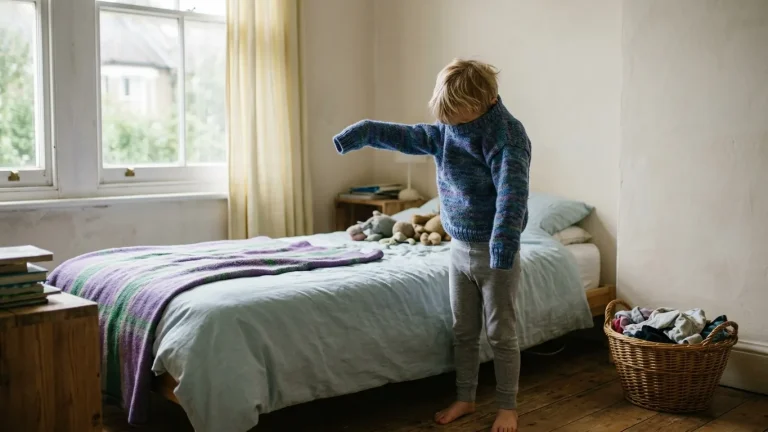
- While dressing, guide out loud: "Right arm first, then left arm."
- Count the steps on the stairs, and ask which hand is on the handrail.
- On walks, play a game with "turn right, turn left" commands.
- Let your child put the fork and knife in their places at the table.
- Stick a coloured "start" sticker in the top left corner of the desk.
- In ball games, switch the target between right and left, which strengthens body awareness.
These habits take five minutes a day. Yet their effect shows in handwriting within weeks. Regular repetition is the one essential condition.
What Are the 5 Most Common Mistakes Parents Make?
Well-meant but unhelpful habits are common with a child who writes letters backwards. The five mistakes below slow progress noticeably.
- Making the child erase a wrong letter and rewrite it again and again, because repetition reinforces the mistake too.
- Working on five different letters on the same day.
- Marking the whole exercise book in red pen.
- Comparing the child with classmates, which only increases anxiety.
- Leaving the teacher out of the process completely.
Instead, choose one target letter and positive feedback. Also keep one handwriting sample each week. This way, you can show progress without arguments.
Which School Adjustments Should You Ask For?
A child who writes letters backwards progresses much faster with support at school too. So arrange a short meeting with the teacher.
- Ask for extra time in written exams.
- Ask for fewer items in long copying tasks.
- Ask whether your child can have printed notes instead of copying from the board.
- Request an oral exam option, because your child's knowledge does not depend on handwriting.
- Ask the teacher to mark handwriting and content separately.
- Use an exercise book with wider line spacing instead of a standard ruled one.
These adjustments are especially helpful when your child is starting school. For more, read our article on occupational therapy for school readiness.
When Is a Specialist Assessment Needed?
Practise regularly at home for eight weeks. If nothing changes in that time, seek a specialist opinion. The signs below are a reason to book sooner.
- Your child is over 7 and still reverses letters every day
- Avoiding writing has turned into anxiety about school
- The teacher finds handwriting legibility below the class level
- Pencil grip problems and hand fatigue come with the reversals
- Your child cannot read what they have written
For example, a child with an incorrect pencil grip shows difficulties with the same underlying skills. Our learning difficulties support page also explains what we cover.
How Does the Occupational Therapy Process Work?
For a child who writes letters backwards, the process starts with a detailed assessment. The occupational therapist first looks at visual perception and sense of direction. Next, they check fine motor strength and pencil control. Then they build a programme tailored to your child.
The programme works on three areas: visual discrimination, motor planning and fluent handwriting. Each session lasts 40 minutes. The therapist also gives the family short daily activities to do at home.
Families usually see the first clear change around the eighth week. However, it takes several months for the skill to become truly automatic. For more, read our article on how an occupational therapy assessment works.
Basic hand skills are also part of the programme. That is why fine motor skills work is included in every session.
How Does Assessment Work at Çocukla Akademi?
For a child who writes letters backwards, the process at our centre in Beykent starts with a single meeting. Our therapist first listens to you and goes through the teacher's notes. Then they give your child a writing task suited to their age. The meeting can take place in English, and bilingual children can do the writing task in English, Turkish or both.
The assessment takes 40 minutes. During this time, the therapist records letter direction, how well your child follows the line and writing speed. Afterwards, you receive a written roadmap.
If needed, our team prepares an occupational therapy programme. If you have questions, write to us through our contact page. Our Beylikdüzü service area page also has travel details.
We hold the first review in the sixth week. In that meeting, the therapist repeats the same writing task. So you can compare progress across two samples.
Frequently Asked Questions
Does a child who writes letters backwards always have dysgraphia?
No. Up to age 7, this is normal for most children. But if illegible handwriting and very slow writing come with it, a specialist assessment is needed. This saves the family needless worry.
Who diagnoses dysgraphia?
A full assessment is usually carried out jointly by an occupational therapist, a psychologist and, when needed, a paediatric neurologist. Our centre handles the first-step assessment. For details, see our book an appointment page.
Does being left-handed make letter reversals more likely?
In left-handed children, confusion about direction can last a little longer. Even so, left-handedness alone does not cause dysgraphia. The right paper angle and pencil grip close the gap quickly.
Is typing on a computer a solution?
A keyboard reduces the load of handwriting, so your child can focus on content. But do not give up handwriting practice completely. The best results come from using both together.
How long does support usually take?
It depends on your child's profile. Families usually see clear progress within three to six months. Regular attendance shortens this time.
What should I do at home instead of criticising?
Tick the letters written correctly and praise the effort out loud. Talking about the number of mistakes lowers motivation. This way, your child sits down to write willingly.