

Symbolic play is when a child uses an object as if it were something else, or acts out a role. The first signs appear at around 18 months, and play becomes much richer between the ages of 2 and 3. In this article we explain the stages of play, how symbolic play links to language and autism, and how to support it at home.
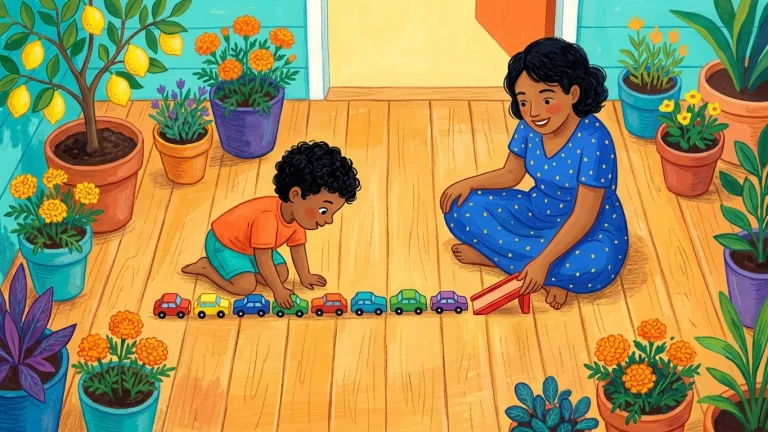
Families often come to us with the same observation: "He lines up his cars but never drives them." This observation is valuable, because play is a window into how a child thinks. Still, a single observation is not a diagnosis.
So the first step is to understand how play develops. Then you can see which step your child has reached. This gives you a concrete plan instead of worry.
What Is Symbolic Play?
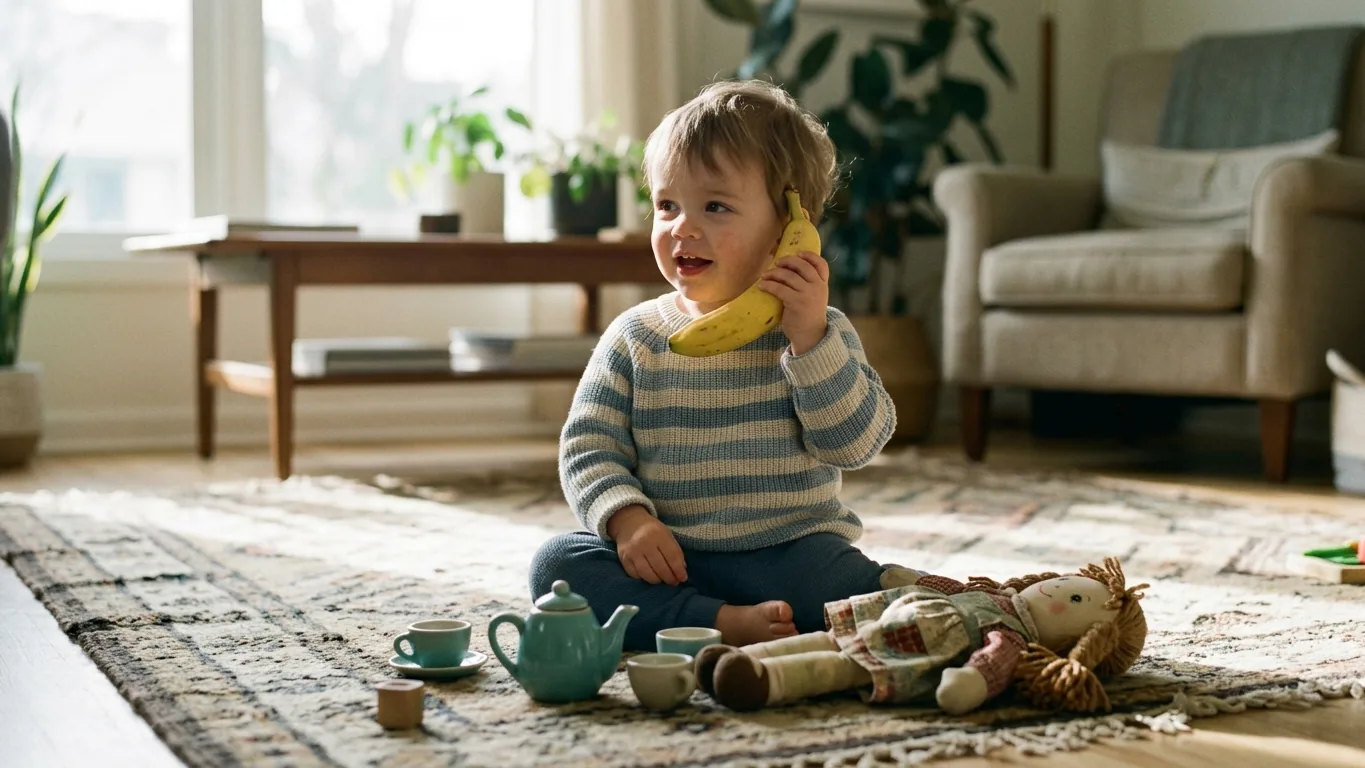
Symbolic play is play in which one thing stands for another. For example, a child turns a banana into a phone, drives a block like a car or puts a doll to bed. In short, the child pretends.
The heart of this play is representation. The child knows what the object really is, but gives it a new meaning in their mind. So symbolic play is more than a sign of imagination: it is a thinking skill.
Specialists also call it imaginative play, pretend play or make-believe play. The name may change, but the test stays the same: the child puts one thing in place of something it is not.
At What Age Does Symbolic Play Start?
The first symbolic actions usually appear between 12 and 18 months. For example, the child pretends to drink from an empty cup or holds a phone to their ear. True symbolic play, however, emerges between 18 and 24 months.
In other words, at this stage the child uses one object in place of another. This shift is the moment play turns into thought.
After the age of two, play quickly becomes richer. The child now links actions in order, feeding the doll and then putting it to bed. At around three, role play begins: the child becomes a doctor, a mum or a driver.
| Age | Stage of play | Example |
|---|---|---|
| 0-12 months | Exploratory and sensory play | Puts objects in the mouth, bangs them, throws them |
| 12-18 months | Functional play | Pushes a car along, holds a phone to the ear |
| 18-24 months | Single-action symbolic play | Uses a block as a phone, gives the doll a bottle |
| 2-3 years | Linked symbolic play | Feeds the doll, then baths it, then puts it to bed |
| 3-4 years | Role play | Plays doctors, gives toys roles |
| 4-6 years | Story-based play with rules | Builds stories with friends, shares out the roles |
The table gives a general framework. The ages are averages, not strict limits. Some children stay longer at one stage, but they do not change the order.
What Is the Difference Between Functional and Symbolic Play?
Functional play means using an object for its real purpose. For example, the child drives a toy car or lifts a spoon to their mouth. Symbolic play means giving an object a new meaning.
The difference looks small, but in terms of thinking it is big. In functional play, the child shows what an object is for. In symbolic play, the child transforms the object in their mind.
That is why it matters to tell the two stages apart. A child who drives a toy car has not yet reached symbolic play. The real sign is turning a block into a car.
How Is Symbolic Play Linked to Language Development?
A word is also a symbol. The word "car" stands for a real car, just as a block stands for a car in play. So the two skills grow from the same mental root.
Research supports this link. Children with rich symbolic play often learn words faster. The stories they build in play also feed sentence building in a natural way.
That is why play is not decoration in language therapy but the main tool. The therapist teaches a word inside the child's play rather than with a flashcard. In a bilingual home this works in both languages: the same toy phone can be a "phone" with one parent and a "telefon" with the other. We cover the language side in our article on language milestones from 0 to 6.
Why Are Imitation and Joint Attention the Foundations?
Symbolic play does not appear out of nowhere. The child first watches an adult's action, then copies it. So imitation is the first building block of symbolic play.
Joint attention is the second. The child and the adult look at the same object together, then share a glance. This turns play from a solo action into a shared story.
If these two skills are weak, symbolic play is delayed too. So in therapy we strengthen imitation and joint attention first. Once this foundation is in place, symbolic play often appears on its own.
Why Is Symbolic Play Less Common in Autism?
Children on the autism spectrum tend to develop symbolic play later and use it less. There are several reasons for this. First, these children often focus more on the physical features of objects, such as a spinning wheel or a flash of light.
The second reason relates to joint attention. Children usually learn symbolic play by copying an adult. In autism, looking at another person's actions and copying them develops less naturally.
The third reason is flexibility. Pretending means setting aside an object's real meaning for a moment. In autism this flexibility is harder to develop, so the child prefers to use objects for their real purpose.
We describe other signs that may go with it in our article on signs of autism in children.
Is a Lack of Symbolic Play a Sign of Autism?
Not on its own. Some children start late because they are shy or have seen few examples. Even so, no symbolic play at all by 24 months is one of the early warning signs.
That is why a specialist looks at play alongside other areas. They also consider eye contact, pointing, response to name and imitation together. This builds a full picture rather than relying on a single observation.
Our article autism or speech delay? also shows this distinction with examples.
Which Warning Signs in Play Should You Watch For?
The table below compares the play expected at each age with the warning signs. First, a key point: a single sign is not a diagnosis, but it is reason enough for an assessment.
| Age | Expected play | Warning sign |
|---|---|---|
| 12 months | Explores objects, copies simple actions | Never copies an adult's actions |
| 18 months | Pretends to drink from an empty cup | Only lines up, spins or throws toys |
| 24 months | Gives the doll a bottle, turns a block into a car | No pretend actions at all |
| 3 years | Links actions in order, takes on short roles | Play is repeated in exactly the same way every time |
| 4 years | Builds stories with other children | Only copies scenes from cartoons |
If you see a warning sign, do not wait. An early assessment both clarifies your concern and, if needed, starts support early.
What Do Lining Up, Spinning and Repetitive Play Tell Us?
Lining up cars is not unusual in itself. Typically developing children also go through a phase of loving order. The difference is whether lining up is the whole of the play.
If the child drives the cars after lining them up, play is moving forward. But if they only line them up, get upset when the line is broken and do not move on to other play, the picture is different. In that case, lining up is not play but a way of calming and organising themselves.
The same logic applies to spinning wheels and watching objects at eye level. Seeing this now and then is normal, but if it takes up most of the play, an assessment is needed. For more, see our article ADHD or sensory seeking?
Memorised Script or Real Symbolic Play?
Some children build long play scripts, but these are exact copies of a cartoon. This can mislead families. The play looks rich, yet there is no flexibility.
The table below helps you tell the two apart. Look at all five features together.
| Feature | Real symbolic play | Memorised script |
|---|---|---|
| Source | The child's own idea | A scene from a cartoon or video |
| Change | The play grows when something new is added | Change causes anger or stops the play |
| Partner | Brings the adult into the play and gives them a role | The adult is only an audience |
| Language | Uses their own sentences | Repeats lines with the same intonation |
| Ending | Ends differently each time | Ends the same way each time |
The most practical way to tell them apart is to add a small change. For example, add a new toy to the play and watch the reaction. Flexible play grows, while memorised play stops.
How Does DIR/Floortime Develop Symbolic Play?
DIR/Floortime is an approach that builds interaction by following the child's interests. Symbolic play sits at the fifth and sixth developmental levels of this approach. So the therapist first strengthens the levels below.
The lower levels are regulation, relating to others and back-and-forth circles of communication. Teaching symbolic play without this foundation does not work. The child needs to come up with the idea, not memorise it.
The therapist joins the child's current play, then takes it one step further. For example, if the child is lining up cars, the therapist puts a garage at the end of the line. This turns lining up into the start of a story.
For details, see our pages what is DIR/Floortime, Floortime for autism and what happens in a Floortime session.
How Can You Support Symbolic Play at Home?
You cannot teach symbolic play like a lesson, but you can model it. The ladder below starts at the bottom step and moves on from where your child is. First, work out which step your child is on.
| Step | What you do | Example |
|---|---|---|
| 1. Do it to yourself | Show the pretend action on yourself | Pretend to drink from an empty cup and say "mmm" |
| 2. Do it to your child | Direct the same action towards your child | Bring the empty cup to your child's mouth |
| 3. Do it to a toy | Do the action with a doll or toy animal | Give the teddy a drink from the cup |
| 4. Transform an object | Use one object in place of another | Turn a block into a phone and say "Hello?" |
| 5. Link actions | Join two or three actions in order | Feed the teddy, bath it, put it to bed |
| 6. Give roles | Choose a role for your child and for yourself | "You be the doctor, I'll be the patient" |
The most important rule is the same at every step: show, then wait. If your child copies the action, respond with enthusiasm. If they do not, show it again and do not push.
Which Toys Make Symbolic Play Easier?
Small copies of real objects are the best choice to start with. For example, a toy phone, plates, a bottle and a doll offer concrete representation. The child links them to the real thing straight away.
In the second stage, open-ended materials come in. For example, blocks, pieces of fabric and boxes can become anything. This way the child learns to give an object meaning with their own mind.
Toys with lights and sounds do not help in this process. They give the same result at the press of a button, so they leave no room for imagination. They also increase sensory focus.
How Does Screen Time Affect Symbolic Play?
A screen offers a ready-made script. The child watches the scene but does not come up with an idea of their own. So as screen time goes up, spontaneous play goes down.
Screens also cut off back-and-forth interaction. Yet symbolic play grows with a partner. So replacing the screen with a play partner is the most effective step.
We cover this in our article how screen time affects language development. Our article on virtual autism looks more closely at difficulties linked to screens.
What Should a Weekly Home Play Plan Look Like?
Families want a clear routine. The plan below takes fifteen minutes a day. Give each day a single goal.
| Day | Focus | Example activity |
|---|---|---|
| Monday | Imitation | Show simple actions in an exaggerated way, then wait |
| Tuesday | Doing it to yourself | Pretend to eat from an empty spoon, then offer it to your child |
| Wednesday | Doing it to a toy | Feed the teddy, then wait for your child's turn |
| Thursday | Transforming objects | Turn a box into a car and put a toy inside |
| Friday | Action sequence | Bath the doll, dry it, put it to bed |
| Saturday | Small change | Add something new to a familiar game |
| Sunday | Free play | Join your child's play without leading it at all |
The plan looks simple, but it needs routine. One long session a week does not make a lasting difference. For more ideas, see our article how to do Floortime at home.
Five Mistakes Parents Should Avoid
Some well-meant reactions can shut play down. We see the following ones especially often.
- Running the play and constantly telling your child what to do
- Turning play into a test with questions like "What's this?" or "What are you doing?"
- Correcting a toy your child is using the "wrong" way
- Buying more toys but forgetting to be a play partner
- Giving up as soon as your child does not copy you, and switching to a screen
Play is an area your child leads. So the adult's job is not to direct, but to join in and expand. The best play partner is the adult who follows the child's idea.
Five Myths About Symbolic Play
Wrong information leads families either to needless worry or to needless waiting. So here we correct the five beliefs we hear most often.
"Every child who lines up cars is autistic"
No. Lining up is not a sign on its own. What matters is whether the play continues after the lining up.
"We can teach symbolic play like a lesson"
You cannot teach it, but you can model it. The child has to come up with the idea. That is why memorised play scripts are not real symbolic play.
"More toys means more play"
Quite the opposite. A few open-ended materials and a play partner work better than a full toy box.
"If they build long scripts, there's no problem"
If the script is a copy of a cartoon, there is no flexibility. So add a small change: if the play grows, it is real.
"A child who doesn't talk can't do symbolic play"
They can. Symbolic play comes before words. The representation built in play prepares the ground for words to come.
When Should You See a Specialist?
If any of the following applies, do not put off booking an assessment. Early support makes use of the window for both play and language development.
- At 18 months, your child does not copy an adult's simple actions
- At 24 months, your child does no pretend play at all
- Your child's play consists only of lining up, spinning or throwing
- A small change to the play causes a meltdown
- All of the play is made up of memorised cartoon scenes
- There is no eye contact or sharing during play
You do not need a diagnosis report to come to us. We describe our autism programme on our Autism Therapy page and our play-based approach in our article on play therapy.
How Does the Process Work at Çocukla Akademi?
First, we hold a detailed meeting with the family. We note your child's favourite toys, how they play and their screen habits. Then the therapist observes your child in free play.
Next, we identify your child's stage of play, imitation skills and joint attention. We then look at their language and sensory profile under the same roof. After that, we set three-month goals together with the family.
Third, the team works together. The Floortime therapist, the speech and language therapist and the occupational therapist use the same list of goals. This joined-up approach helps play move to the next step faster.
Our founder, Alev Akıncı Yıldız, is a Specialist Audiologist (MSc) and a DIR/Floortime therapist. Each session lasts 40 minutes. Our Play Group Programmes also give children a chance to practise with peers.
Families come to our centre in Beykent, Büyükçekmece from Beylikdüzü, Esenyurt and Bahçeşehir. Therapy is available in English, and family meetings and progress updates can be in English too. For details, see our Our Centre page, and you will find appointment information on our Contact page.
Frequently Asked Questions
Is symbolic play the same as imaginative play?
Yes, both terms describe the same kind of play. Some sources also call it pretend play or make-believe play.
My child lines up cars but doesn't drive them. Should I worry?
Lining up is not a problem on its own. If the play does not continue after the lining up and changes cause anger, ask for an assessment.
Does symbolic play speed up language development?
Yes, because a word is also a symbol. A child who builds representations in play learns words more easily and carries them into sentences.
Can an autistic child learn symbolic play?
Yes, with the right support. The therapist first strengthens imitation and joint attention, then shows pretend actions step by step.
Which toys are good for symbolic play?
At first, small copies of real objects, and later open-ended materials such as blocks and boxes. Toys with lights and sounds leave no room for imagination.
Does acting out cartoon scenes count as symbolic play?
If it is an exact copy, it is not real symbolic play. Add something new to the play: if your child expands the play, it is real symbolic play.
How much play a day is enough at home?
Fifteen minutes of focused, regular play a day is enough. Long but rare play sessions do not bring the same benefit.
How does Floortime develop symbolic play?
The therapist joins the child's current play and expands it by one step. Small additions, like putting a garage at the end of a line of cars, start a story.
Can we work on symbolic play with a child who doesn't talk?
Yes, in fact the therapist often works on this first. Symbolic play comes before words and prepares the ground for them.
Do I need a diagnosis report for an assessment?
We do not ask for a report for the first meeting. You can contact us directly with what you have noticed.
At how many months does symbolic play start?
The first pretend actions appear between 12 and 18 months. Using one object in place of another usually emerges between 18 and 24 months.
Is a child who doesn't do symbolic play autistic?
Not on its own. Even so, no symbolic play at all by 24 months is one of the early warning signs and calls for an assessment.
In short, symbolic play is a window into a child's thinking and language skills. It emerges between 18 and 24 months, but appears later and less often in autism. So the right approach is to model rather than teach, and to join in rather than direct.