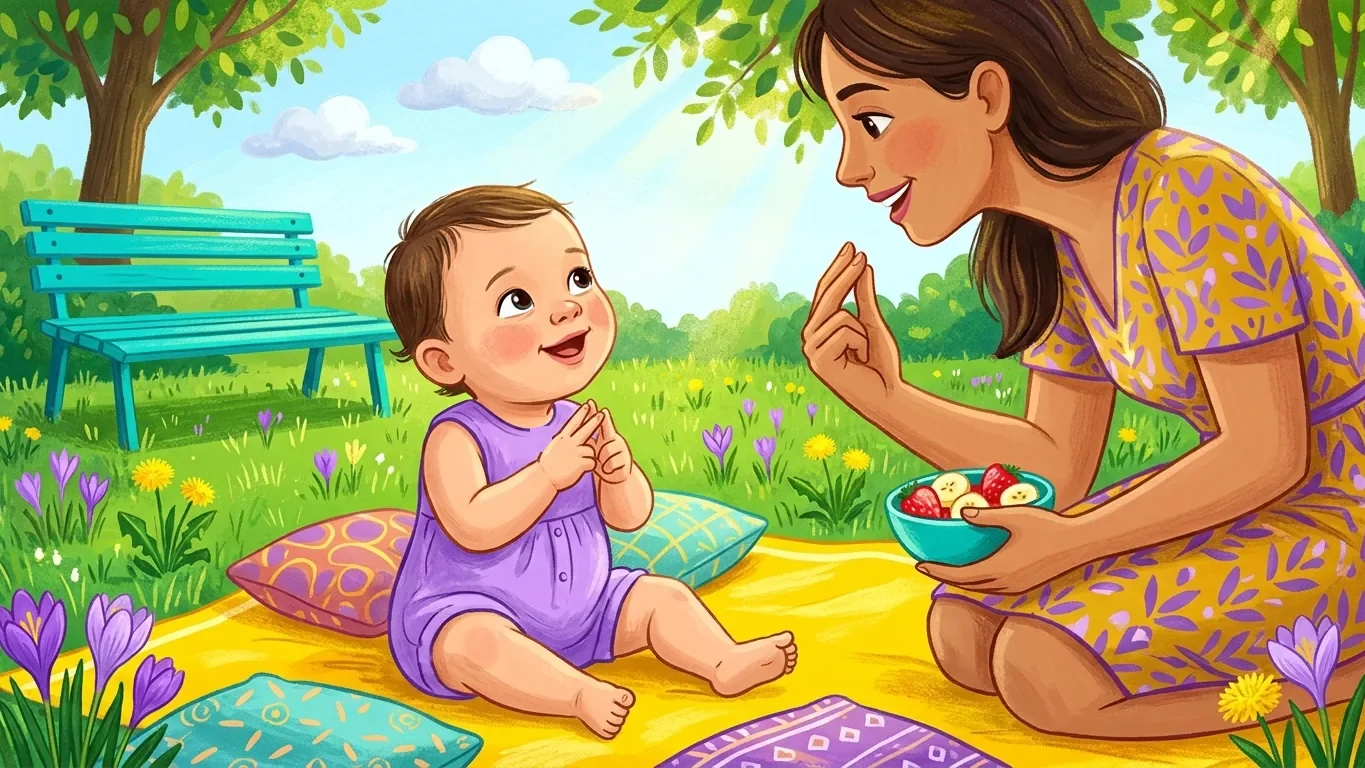
Baby sign language means a baby who cannot talk yet uses simple hand movements to ask for basic things like "more", "all done" or "milk". Yet many parents ask the same question: does baby sign language delay speech? In this guide we explain what the research really says, when to start, the first 10 signs and a 6-step plan you can use at home.
Take ten-month-old Defne. She would fuss in her high chair, cry and push the spoon away. Her mother tried water, then a biscuit, but the crying did not stop.
A few weeks later Defne began to tap the fingertips of both hands together. This was the sign for "more", the word her mother said with every spoonful. Soon the crying gave way to a quick little hand movement.
When parents at our centre describe moments like this, they usually feel two things at once. There is excitement, and there is worry: "What if signing replaces talking?" So let us look at that worry first.
What is baby sign language?
Baby sign language works like this: as you say a word, you make a simple hand movement at the same time. Over time your baby copies the movement and uses it to tell you what they want.
However, baby sign language is not a full language. Baby sign language is only a handful of signs, and it always goes together with speech. A national sign language, such as Turkish Sign Language or British Sign Language, is a complete language with its own grammar, used by Deaf communities.
| Term | What it means | Who uses it |
|---|---|---|
| Natural gesture | Waving, pointing with the index finger, raising arms | Almost every baby, without being taught |
| Baby sign language | 10 to 30 simple signs taught alongside words | Hearing babies and their families |
| National sign language (Turkish, British or American) | A complete language with its own grammar | Deaf people, their families, interpreters |
| Augmentative communication | Supporting speech with signs, picture cards or a device | Children with a clear speech delay |
In short, the baby sign language in this guide is a temporary bridge a hearing baby uses on the way to speech.
Why do babies talk with their hands first?
Because the muscles of the hands mature earlier than the fine coordination of lips, tongue and breath that speech needs. That is why many babies wave, point or lift their arms before they say their first word.
Researchers Linda Acredolo and Susan Goodwyn published an important observation in 1988. Babies invent their own gestures for objects and needs, even when nobody teaches them. What is more, babies who used more gestures also had larger vocabularies.
Then in 2005 Jana Iverson and Susan Goldin-Meadow showed a clearer link. Most of the things children first named with a gesture turned up as spoken words a few months later. For example, a child who pointed at a bird and said "nap" soon put two words together: "bird nap".
Next, Meredith Rowe and Goldin-Meadow followed 50 children in 2009. Children who gestured a lot at 14 months had larger vocabularies at 54 months.
Their gesture use was also closely linked to how much their parents gestured.
Put simply, gesture is not the rival of language but its forerunner. We cover this in our articles on joint attention and imitation skills too.
Does baby sign language delay speech? What the research says
The short answer: no, there is no research showing that it delays speech. However, there is no strong evidence that it clearly speeds speech up either.
First, Goodwyn and Acredolo followed 22 babies in 1993. These babies started using signs a little before words. However, the gap was much smaller than earlier claims had suggested.
Then in 2013 Elizabeth Kirk and her team published the first randomised controlled trial in this area. They followed 40 babies from 8 to 20 months of age.
In the end, the language development of babies taught to sign was no different from the control group.
On the other hand, the same study had an interesting finding. Mothers who learned to sign were more responsive to their babies' non-verbal cues. They also encouraged their babies to do more things independently.
Finally, Fitzpatrick and colleagues reviewed studies with hearing babies systematically in 2014. They screened 1,902 records and examined the 10 reports that met their criteria.
As a result, they found no conclusive evidence that signing benefits language. At the same time, they found no evidence that it causes harm.
| Common claim | What the research says |
|---|---|
| Baby sign language delays speech | No finding supports this |
| Baby sign language makes babies talk early | Controlled studies found no language difference |
| Signs can come before words | Yes, but the gap is small, a few weeks |
| It boosts intelligence | No reliable evidence |
| It helps parents read their baby | One controlled study points in this direction |
The Hanen Centre in Canada reaches a similar conclusion in its article on baby signing. In other words, the value of signing comes less from speeding up words and more from creating more moments of communication.
Where is the real benefit of baby sign language?
Baby sign language is not a miracle method. Used well, though, it makes three real contributions to communication at home.
- You watch your baby more closely. While waiting for a sign, you notice your baby's gaze, reaching and sounds more often. This attention is the foundation of language development.
- You say the word more often and more clearly. Because every sign comes with the same word, your baby hears that word dozens of times a day.
- Requests get quicker. For example, a "more" or "all done" sign can shorten the guessing game. However, there is no strong evidence yet that this reduces crying.
So think of baby sign language as a communication game you play together, not as a test of achievement.
When should you start baby sign language?
You can usually start showing signs at around 6 to 8 months. However, most babies make signs themselves between 8 and 12 months.
This is because a baby first needs to follow your gaze and copy hand movements.
The table below is based on the gesture items in the US Centers for Disease Control and Prevention (CDC) milestones. The CDC sets each milestone at the age at least 75 percent of children reach it.
| Age | Expected gestures and communication | What it means for signing |
|---|---|---|
| 6 months | Takes turns making sounds, smiles at familiar faces | You can start showing signs |
| 9 months | Lifts arms up to be picked up | First attempts to copy may appear |
| 12 months | Waves bye-bye, says "mama" or "dada" | May use a few signs with meaning |
| 15 months | Points to ask for something | Signs and single words grow together |
| 18 months | Tries to say three or more words | Words start to replace signs |
| 24 months | Puts two words together | Signs usually fade on their own |
You can find the full set of speech milestones by age in our language development milestones from 0 to 6 article.
The first 10 signs in baby sign language
The "correct" form of a sign matters less than everyone at home using the same form. So treat the signs below as simple home signs. If you like, you can learn the official forms from a British or American Sign Language or a Turkish Sign Language resource.
| Word | Simple sign | When to use it |
|---|---|---|
| More | Tap the fingertips of both hands together | At meals, in tickle games |
| All done | Turn palms up and shake them side to side | When the plate is empty, when a game ends |
| Milk | Open and close one fist | Before breastfeeding or a bottle |
| Water | Hold an imaginary cup and bring it to your mouth | Between meals, after bath time |
| Eat | Bring bunched fingertips to your mouth | Before sitting in the high chair |
| Sleep | Put your palms together and rest them on your cheek | At the start of the bedtime routine |
| Up | Raise both arms | When your baby wants to be picked up |
| Bath | Rub your chest with your fists | While filling the bath |
| Book | Put your palms together and open them like a book | At story time before bed |
| Help | Place one fist on your other palm and lift | When a lid will not open, when a toy gets stuck |
However, do not start with all ten at once. Instead, begin with the 2 or 3 signs that come up most often in your day. For example, "more", "all done" and "milk" are a good start in most homes.
Baby sign language at home in 6 steps
- Always say the word out loud. Never sign in silence. That way your baby learns the hand and the sound together.
- Get down to eye level. Make the sign next to your face, because your baby should be able to see both your hand and your lips.
- Use the real moment. Sign "milk" just before the milk arrives. Also, do not practise signs in a separate lesson.
- Pause for a moment. After you sign, wait a few seconds and look at your baby. This pause tells your baby it is their turn.
- Accept an approximate sign. For example, "more" may look like clapping. Do not correct it; simply say the word again clearly.
- When words arrive, put speech first. When your baby starts saying "muh", respond to the sound with delight. Then let the sign fade over time.
Above all, baby sign language works when everyone at home uses the same sign. So other adults and your childminder should use the same forms too. You can also stick a small baby sign language list on the fridge.
How do signs turn into words?
For families using baby sign language, the moment they wonder about most is when a sign becomes a word. This change rarely happens overnight; it usually takes a few months and four stages.
| Stage | What you see | How you respond |
|---|---|---|
| 1. Sign only | Makes the "more" sign silently | Say "More! More apple." and give it straight away |
| 2. Sign and sound | Says "muh" or "ah" with the sign | Repeat the sound happily: "Muh! More!" |
| 3. Word and sign | Says "more" and the hand still moves | Add one step: "More water." |
| 4. Word only | The sign disappears, the word stays | Add new words and two-word phrases |
Stage two in particular is an important turning point, because your baby has started to add their voice to their hand.
The Iverson and Goldin-Meadow finding points to exactly this moment. For example, children who combined a gesture with a word also moved to two-word sentences sooner.
So if your baby signs "water" and says "mama", count it as a first step towards a two-word sentence. Then complete it out loud: "Mama, you want water."
On the other hand, some children stay at stage three for a long time. This is usually not a problem. However, if the number of signs keeps growing while the number of words does not grow at all, talk to a specialist.
Signing opportunities in daily routines
Baby sign language does not need a separate play time. On the contrary, the best opportunities are routines that repeat in the same order every day.
| Routine | Sign | What you can say with it |
|---|---|---|
| Breakfast | More, all done | "Do you want more? More yoghurt." |
| Getting dressed | Help | "Your arm is stuck. Shall I help?" |
| Park | More, up | "The slide again! More!" |
| Bath | Bath, water | "Bath time. Lovely warm water." |
| Story time | Book, sleep | "Let's read a book. Then sleep." |
We explain how to make story time more talkative in our reading to your child article. For other games that fit your routines, see our language development activities at home article.
5 common mistakes
- Signing in silence. If baby sign language replaces speech, your baby misses the chance to hear the word.
- Starting with too many signs. Twenty signs at once tire the parent, not the baby, and consistency is lost.
- Testing your baby. "Show me, how do we sign milk?" turns the game into a test. Instead, use the sign at the real moment of need.
- Meeting every request instantly. If you hand over the toy the moment your baby reaches, there is no need for a sign. So pause for a moment.
- Seeing signs as a cure for speech delay. Signing is a good support. However, it does not replace an assessment when speech is clearly delayed.
Does teaching signs help a child with speech delay?
Yes. In fact, signs and picture cards are common tools in therapy for children whose speech is delayed. Specialists call these supports "augmentative and alternative communication".
Parents often have the same worry here. However, research shows that augmentative communication does not block speech and often supports it. We cover this in detail in our PECS and augmentative communication guide.
Signs can help a child express themselves especially in these situations:
- Children who understand many words but can say only a few (see receptive vs expressive language)
- Children who find it hard to plan speech sounds (see childhood apraxia of speech)
- Children whose speech and language development with Down syndrome is being followed
- Children who have intense meltdowns when they are not understood (see managing temper tantrums)
That said, for these children the choice and order of signs should be planned with a therapist. The goal is not to make signs a permanent system but to build a bridge to spoken language.
Signs but no sounds: an audiologist's view
Some babies pick up signs quickly but never babble. In this case the first question is about hearing.
Babies who hear well usually make syllables like "ba-ba" or "da-da" by 10 months.
Indeed, babies with hearing loss often have strong gestures and signs but weak syllables. So if your baby is 10 or 11 months old and not making syllables, do not delay a hearing assessment.
We explain the details in our articles on cooing and babbling and the child not responding to their name.
On the other hand, for a child diagnosed with hearing loss, a national sign language is far more than baby signing. In that case the family, the doctor and the audiologist need to weigh sign language, hearing aids or cochlear implants and auditory rehabilitation together.
When should you see a specialist?
Baby sign language is a good window for watching development. However, if you notice any of the following, do not wait:
- No gestures at all by 12 months, such as waving, pointing or raising arms
- No babbling with syllables by 10 or 11 months
- No meaningful single word by 15 or 16 months
- Not pointing to show what they want and fewer than three words by 18 months
- Not turning to their name consistently
- Losing signs or words they used before
Each of these can have different causes. So first talk to your paediatrician and have your child's hearing checked. Then you can get support from a speech and language therapist.
For a more detailed age-based roadmap, see our 2-year-old not talking article.
How does the process work at Çocukla Akademi?
At the first meeting we listen to how your baby communicates, which gestures they use and which sounds they make. Then we observe joint attention, imitation and turn-taking during play. We describe this observation step by step in our speech and language assessment article.
If needed, we plan speech and language therapy. Sessions last 40 minutes, take place in person at our centre in Beykent, Büyükçekmece, and are available in English, with bilingual Turkish-English sessions too. In Parent Guidance meetings we also decide together which signs to start with at home and how to carry them into spoken language.
4 myths about baby sign language
- "Babies who sign get lazy and do not talk." No research finding supports this. On the contrary, gesture use usually grows together with vocabulary.
- "Start early and they will talk early." Controlled studies did not confirm this. So do not treat signing as a race.
- "Signs must be taken exactly from a national sign language." For a hearing baby, consistency matters most. However, using official signs is also a good choice.
- "If my baby does not sign, something is wrong." Some babies never take to signing and go straight to words. What matters is their overall wish to communicate.
Frequently asked questions
Does baby sign language delay speech?
No, there is no research showing that it delays speech. However, controlled studies have not shown that it clearly speeds speech up either. Its biggest contribution is creating more moments of communication between parent and baby.
At what age should you start baby sign language?
You can usually start showing signs at around 6 to 8 months. Most babies then begin making signs themselves between 8 and 12 months.
How many signs should I start with?
For baby sign language, start with the 2 or 3 signs that come up most often in your day. For example, "more", "all done" and "milk" are a good start. Add new signs once your baby uses these.
Is baby sign language the same as a national sign language?
No. Baby sign language is a few simple signs that go along with speech. A national sign language, such as Turkish or British Sign Language, is a complete language with its own grammar.
My baby signs but makes no sounds. What should I do?
If your baby is 10 or 11 months old and has not started babbling with syllables, do not delay a hearing assessment. Also share this observation with your paediatrician.
My child has started talking. Should we stop signing?
There is no need to force it. Children usually drop a sign on their own once they can say the word. You can support this change by responding more to the word.
Can we use signs in a bilingual home?
Yes. You can use the same sign with the word in both languages, for example "more" in English and "daha" in Turkish. That way the sign becomes a bridge linking two words to one meaning. See our bilingualism article for details.
Can you teach signs to a 2-year-old with speech delay?
Yes, signs help children with speech delay too. At this age, however, it is important to understand the cause of the delay first. So choose signs together with a speech and language therapist.
Related articles
For using signs and words together in a bilingual home, our does bilingualism delay speech article can guide you. For the next step after first words, read our ways to expand your child's vocabulary article, and for the wider picture of delay, see our speech delay page.
Sources
The research information in this article is based on these sources:
- Acredolo L, Goodwyn S. Symbolic gesturing in normal infants. Child Development, 1988.
- Goodwyn SW, Acredolo LP. Symbolic gesture versus word: is there a modality advantage for onset of symbol use? Child Development, 1993.
- Iverson JM, Goldin-Meadow S. Gesture paves the way for language development. Psychological Science, 2005.
- Rowe ML, Goldin-Meadow S. Differences in early gesture explain SES disparities in child vocabulary size at school entry. Science, 2009.
- Kirk E, Howlett N, Pine KJ, Fletcher BC. To sign or not to sign? The impact of encouraging infants to gesture on infant language and maternal mind-mindedness. Child Development, 2013.
- Fitzpatrick EM et al. How HANDy are baby signs? A systematic review of the impact of gestural communication on typically developing, hearing infants under the age of 36 months. First Language, 2014.
- CDC. Learn the Signs. Act Early: developmental milestones.