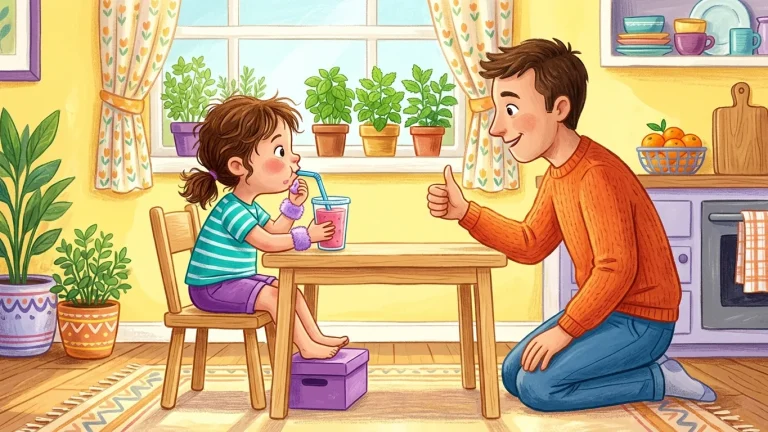
When a child does not respond to their name, there are three main possibilities: hearing, attention and social communication. Babies usually start turning to their name at 7-9 months, and by 12 months the response becomes consistent. In this article we explain how we tell the three apart, and we give you a seven-day play plan to use at home.
"My child doesn't look at me when I say their name" is one of the most common first sentences we hear at our centre. Parents often read online that this behaviour is a sign of autism. Yet not responding to a name is not a diagnosis on its own. It is only a sign.
Sometimes there is a little middle ear fluid behind it. Sometimes the child is simply absorbed in play. And sometimes there really is a social difference. So the right question is not "Is it autism?" but "In which situations, and how consistently?"
When Do Babies Respond to Their Name?
Babies start turning to their name consistently at around 7-9 months. But the first signs come earlier. For example, a baby of 4-6 months turns their head towards a sound.
At first, this response does not happen every time. Consistency builds up gradually until about 12 months. The table below sums up what to expect at each age.
| Age | Expected response | Warning sign |
|---|---|---|
| 0-3 months | Startles at sudden sounds, calms to a familiar voice | No reaction at all to loud sounds |
| 4-6 months | Turns their head towards sounds, looks at the person calling | Has not started turning towards sounds |
| 7-9 months | Often turns to their name, joins in sound games | Rarely turns to their name |
| 10-12 months | Turns to their name consistently, understands "no" | Turns fewer than two times out of five calls |
| 12-18 months | Comes when called from another room, follows simple instructions | Only looks when touched |
| 18-24 months | Looks up at their name even in a crowd, follows "give it to me" | Used to look, but no longer does |
The last row of the table is especially important. If a child is losing a skill they had before, we want an assessment straight away, at any age. We have gathered the overall timeline of language development in our article on language development milestones from 0 to 6.
Three Possibilities When a Child Does Not Respond to Their Name
Not responding to a name comes from three main sources: hearing, attention and social communication. Each one has different clues. So in an assessment we look at hearing first, then attention, and social communication last.
This order is not random. A hearing problem is the easiest cause to measure and the easiest to solve. Also, until hearing is clear, we cannot safely interpret the other two areas.
First Possibility: Can Your Child Really Hear?
Even if a baby passed the newborn hearing screening at birth, hearing can change later. Some types of hearing loss start late or get worse over time. And the most common cause, middle ear fluid, often appears after the screening.
Middle ear fluid builds up after colds and other upper respiratory infections. This fluid can turn sound down by around 20-40 decibels. So the child hears the door slam but misses their name said in a soft voice.
The first question our founder, Specialist Audiologist Alev Akıncı Yıldız, asks parents is: "When was your child's last hearing test?" Most families only remember the newborn screening. Yet when a child does not respond to their name, an up-to-date hearing test is essential.
At a hearing clinic, the audiologist chooses tests that suit the child's age. The table below shows what each test measures.
| Test | What it measures | Suitable age |
|---|---|---|
| Otoacoustic emissions (OAE) | The response of the hair cells in the inner ear | From birth |
| Tympanometry | Eardrum movement and middle ear fluid | From birth |
| ABR (auditory brainstem response) | The electrical response of the hearing nerve to sound | During sleep, any age |
| Visual reinforcement audiometry | Measures a baby turning to sound, using a light-up toy | 6 months to 2.5 years |
| Play audiometry | The child signals with a toy when they hear a sound | 2.5 to 5 years |
All of these tests are painless, and most take 20 to 30 minutes. If a hearing loss is found, we explain the next steps in our article on auditory rehabilitation.
Second Possibility: Does Your Child Hear but Not Shift Attention?
Some children hear their name but do not let go of what they are doing. For example, a child building a tower or watching cartoons may not register the voice at all. Children who are developing typically do this often, too.
Parents usually call this "selective hearing". But the key clue is what happens outside play. Attention-related non-response only happens during deep play, and it disappears at mealtimes or bath time.
Screens make this picture clearly worse. Screen time of more than two hours a day weakens the response to a name. We look at this link in detail in our article on virtual autism.
Sensory processing plays a part here too. For example, a child with a low registration profile notices sounds late. In noisy places such as nursery, these children may miss their name completely. Our article on sensory processing disorder symptoms describes this profile.
Third Possibility: Is It a Social Communication Difference?
In autism, not responding to a name does not come alone. Instead, it comes together with a set of social signs. For example, eye contact is limited, the child does not point and does not share their interest.
Most autistic children hear environmental sounds perfectly well. Parents often say, "They can hear a chocolate wrapper from three rooms away." But the human voice, especially their own name, does not draw the same interest.
Research counts not turning consistently to their name at 12 months as one of the earliest signs of autism. Even so, this sign alone does not lead to a diagnosis. We list the other signs of autism in our article on signs of autism in children.
Joint attention is the key idea here. When a child turns to their name, they are really saying "I'm interested in you." If this skill is missing, speech is usually delayed as well, so we cover the difference in our article autism or speech delay.
Fourth Clue: Does Your Child Hear and Turn, but Not Understand?
Some children turn to their name but do not understand what comes next. For example, when you say "Mia, bring me the ball," the child looks at you but does not go to the ball. This is not hearing loss or autism. It is a receptive language difficulty.
Receptive language is a child's ability to make sense of the words they hear. This skill develops before speech and lays the foundation for it. So if your child turns to their name, the next question should be "Do they understand instructions?" In a home with Turkish and English, check this in both languages, because a child may follow an instruction in one language before the other.
Parents often miss this difference. Because the child looks at them, they think, "They hear me, they just won't do it." A speech and language therapist can bring out this difference in a short assessment, and we explain more on our language disorder page.
How Can You Tell the Three Apart at Home?
Only a specialist can make a firm distinction. But a week of observation at home speeds up the assessment a great deal. So the table below compares everyday clues for the three possibilities.
| Observation | Hearing-related | Attention-related | Social communication-related |
|---|---|---|---|
| Reaction to environmental sounds | None to soft sounds, reacts to loud noise | Present | Present, sometimes even too strong |
| When they see your face | Looks at once, watches as if lip reading | Looks | A brief, fleeting glance |
| When called in a quiet room | Hears close up, not from a distance | Turns if not playing | Unclear whether they turn, even close up and in quiet |
| Pointing and showing | Present | Present | Limited or absent |
| When you raise your voice | Improves | No change, turns when touched | Usually no change |
| Speech development | Unclear sounds, speaks loudly | Age-appropriate | Delayed or repetitive |
This table is not a diagnostic tool. But it shows which specialist to see first. For example, if the first column fits best, see an audiologist. If the third column fits best, a developmental assessment is the first step.
A Simple Way to Record Name Response
For one week, call your child's name ten times a day. Each time, note three things: the setting, the distance and the result. One notebook page with three columns is enough. This way you take a clear record to the specialist instead of "sometimes they look."
- Setting: Is it quiet, is the TV on, is your child playing?
- Distance: Side by side, two metres away or in another room?
- Result: Turned at once, turned late, did not turn, only paused.
This record often reveals the pattern on its own. For example, "turns in quiet, does not turn with the TV on" points towards hearing. By contrast, "does not turn anywhere but startles at noises" points towards social communication.
A Seven-Day Plan to Build Name Response at Home
Responding to a name is a skill that can be taught. So whatever the cause, practising at home does no harm. The plan below takes 10-15 minutes a day and runs through play.
| Day | Game | Goal |
|---|---|---|
| 1 | At eye level in a quiet room, say their name and tickle them straight away | Linking the name with something fun |
| 2 | Say their name, and when they turn, show them a favourite toy | Rewarding the turn |
| 3 | Call from one metre away, and blow bubbles when they turn | Increasing the distance |
| 4 | Start a favourite song with their name: "Mia, here we go!" | Making the name part of the routine |
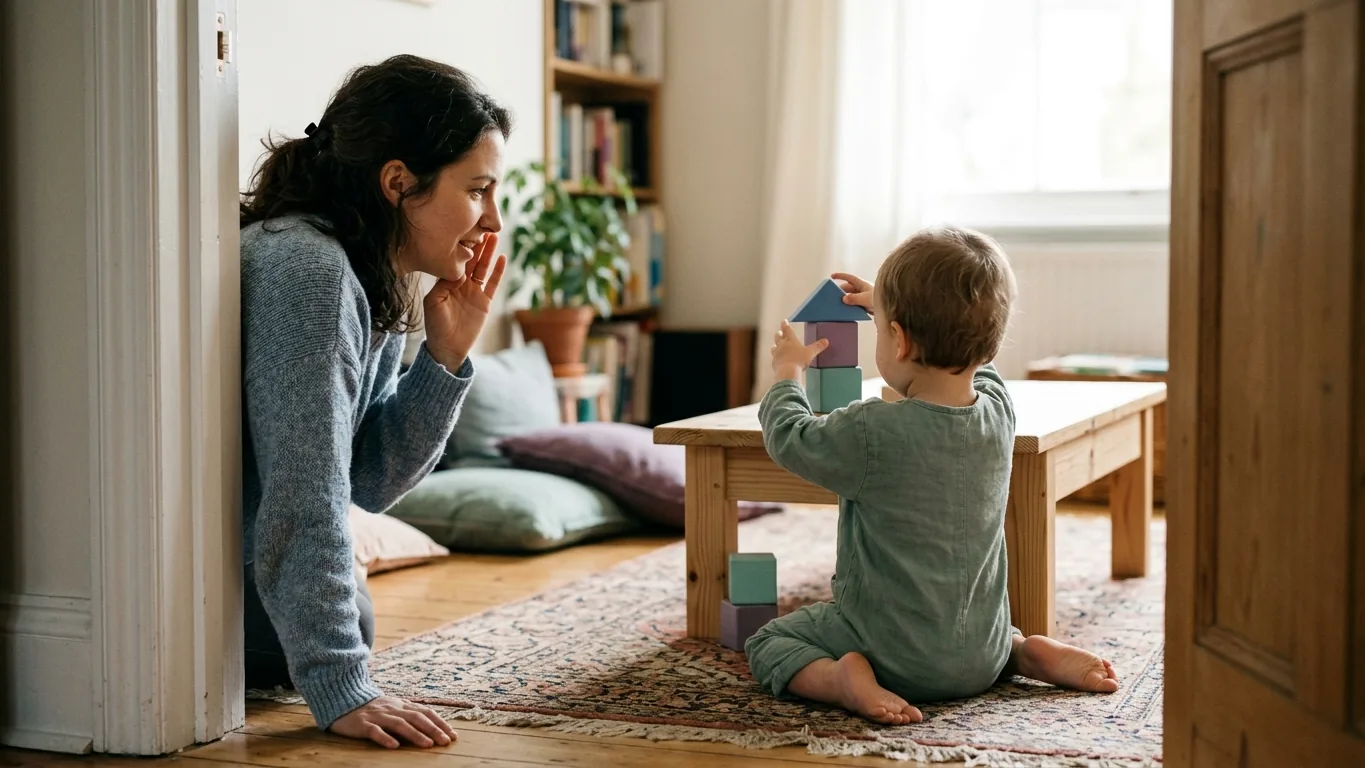
| 5 | Call from behind the door, and play peekaboo when they turn | Turning to a voice without seeing you |
| 6 | Call during light play, and join the game when they turn | Learning to shift attention |
| 7 | Compare this week's number of turns with the week before | Measuring progress |
The golden rule of the plan is simple: say their name only before good things. A name used as "Mia, stop that!" slowly becomes a sound the child avoids. For more play ideas at home, see our article on activities that support language development.
Six Common Mistakes Parents Make
Some well-meant habits actually weaken the response. So we list the six mistakes we see most often. Most families make at least two of them.
- Repeating the name again and again. Calling "Mia, Mia, Mia!" turns the name into background noise. Instead, say it once and wait five seconds.
- Using too many nicknames. With "sweetie", "honey" and "princess", the child hears their own name less often. So stick to one name while they are learning.
- Calling with a screen on. A screen drowns out every other sound. So practise during screen-free times.
- Pairing the name with a telling-off. If you only use the name as a warning, the child learns to avoid it.
- Raising your voice. Shouting hides a hearing problem and startles the child. A normal tone of voice shows the real picture.
- Touching without waiting. If you touch the child straight after every call, they turn to the touch, not the voice. So wait five seconds first.
Five Myths About Name Response
Wrong information either frightens families for no reason or holds them back. So here we correct the five beliefs we hear most often.
"If they don't look at their name, it must be autism"
No. Hearing, attention and receptive language difficulties can cause the same behaviour. And in autism, this sign always comes with other social signs.
"They passed the newborn hearing test, so hearing can't be the problem"
Not true. Middle ear fluid and late-onset hearing loss can appear after the screening. That is why an up-to-date test is always the first step.
"Boys respond later, so we should wait"
A child's sex does not change what we expect at 12 months. Waiting only loses valuable months for early support.
"If they hear environmental sounds, their hearing is fine"
Not so. A door slamming is loud, while the human voice is soft and high-pitched. So a mild hearing loss may only affect speech sounds.
"If they don't look, they are being stubborn"
A one-year-old does not ignore their name out of stubbornness. Instead, they either did not register the sound or could not make sense of it.
When Should You See a Specialist?
If any of the following apply, do not put off booking an assessment. Early support gives the strongest results for both hearing and social communication.
- Your child is over 12 months and does not turn to their name consistently
- At any age, your child used to turn to their name but no longer does
- Along with not responding to their name, eye contact and pointing are also limited
- Your child has frequent ear infections or a long-lasting blocked nose
- Your child's speech is also behind that of children the same age
- In a week of home records, your child turned less than half of the time
You do not need a diagnosis or report to book. We also explain how an assessment works in our article on speech and language assessment. If your child is also late to talk at two, our article on the 2-year-old who is not talking will guide you.
How Does the Process Work at Çocukla Akademi?
First, we hold a detailed meeting with the family. We look in particular at your child's hearing history, how often they have infections and your home record. Then our founder, Specialist Audiologist Alev Akıncı Yıldız, reviews the hearing picture. We do not carry out hearing tests ourselves, so if there is no recent test, we recommend one at a hospital audiology unit or hearing clinic first.
Second, our speech and language therapist looks at receptive language through play and everyday instructions. This way we separate whether your child hears their name from whether they understand it. We explain this difference in our article on receptive and expressive language.
Third, if needed, we carry out a developmental observation. If there is a social communication difference, we build joint attention through play with DIR/Floortime. Turning to a name is a natural result of shared attention, the first stage of Floortime.
Each session lasts 40 minutes. Our Parent Guidance also helps you keep the seven-day plan going at home. For children with an autism diagnosis, our autism therapy page describes the programme.
Our centre is in Beykent, Büyükçekmece (Istanbul) and welcomes families from Beylikdüzü, Esenyurt and Bahçeşehir. All therapies and family meetings are available in English, and bilingual Turkish-English sessions are available for bilingual children. See the Our Centre page for details. You will find booking details on our Contact page.
Frequently Asked Questions
When do babies respond to their name?
Most babies start turning to their name at 7-9 months. We expect a consistent response by 12 months. After this age, turning fewer than two times out of five calls needs an assessment.
My 17-month-old does not respond to their name. What should I do?
First, get an up-to-date hearing test. Then keep a home record for a week and book a language and developmental assessment. At 17 months, every month of early support is valuable.
Is it normal for a 2-year-old not to respond to their name?
No, we expect a consistent response at two. Missing it now and then during play is normal. But if your child does not turn even in a quiet room, get an assessment without delay.
Is every child who does not look at their name autistic?
No. Hearing problems, attention and receptive language difficulties can cause the same behaviour. In autism, this sign comes with others, such as limited eye contact and not pointing.
My child only hears when they want to. What does this mean?
This often describes attention-related non-response. The child does not register a voice while absorbed in play, but turns at once to sounds that interest them. Still, a mild hearing loss can look the same, so a hearing test is essential.
If my child passed the newborn hearing test, do they need another one?
Yes. Middle ear fluid and late-onset hearing loss can appear after the screening. So when a child does not respond to their name, an up-to-date test is the first step.
Which hearing test is needed?
The audiologist at a hearing clinic chooses by age. For young babies this is usually OAE, tympanometry and, if needed, ABR during sleep. After six months they add visual reinforcement audiometry, and after two and a half years, play audiometry.
What can I do to help my child respond to their name?
Say their name just before something enjoyable, stick to one name and practise during screen-free times. The seven-day plan in this article puts these steps in order through play.
What are some name response activities?
Tickling, bubbles, peekaboo and starting a song are the four most effective activities. Each one links the name with something the child enjoys. None of them needs special equipment.
Does screen time affect name response?
Yes. Long screen time clearly weakens a child's response to the human voice. So cutting down screen time makes a difference for most children within a few weeks.
How do you tell a receptive language difficulty from not responding to a name?
With a receptive language difficulty, the child turns to their name but does not understand instructions such as "bring me the ball". When a child does not respond to their name, the turn itself is missing. So the two need different assessments.
Do we need a diagnosis report for an assessment?
No report is needed for the first meeting. Instead, contact us directly with your observations and your home record.
In short, when a child does not respond to their name, we look at hearing first, then attention, and social communication last. A week of home records makes this much easier. So rather than waiting, keep the record, get your child's hearing tested and take early action.