The vestibular system is the sense of balance in the inner ear that tells the brain about movement, speed and gravity. It helps a child sit upright, keep their eyes steady and move with confidence. In this guide we explain how the vestibular system works, the 4 profiles we see in children, when to see a doctor first and 10 games you can play at home.
Five-year-old Arda always stood in the same spot at the park. While the other children ran to the swings, he clung to his mother's leg. To get off the slide, he climbed back down the ladder.
His cousin Ela was the opposite. She would spin round and round at home for minutes, leap from sofa to sofa and never feel dizzy. Both families had brushed it off as "just personality".
In fact, both children's behaviour came from the same sensory system. So what is the vestibular system, and how does it explain two such opposite pictures?
What is the vestibular system?
First, picture your inner ear as a tiny spirit level. Right next to the hearing organ sit fluid-filled canals and minute crystals. When the head moves, this fluid and these crystals shift too.
The sensory cells in the canals then send a message to the brain. It reports which way the head is turning, how fast it is going and where it is in relation to the ground. This whole network is the vestibular system.
Two different structures in the inner ear work together. The semicircular canals sense turning. The otolith organs sense moving forwards and backwards, a lift going down and the head tilting.
So the vestibular system is a "hidden" sense alongside the five classic ones. In occupational therapy we count the vestibular system as one of three core senses, together with touch and body awareness. We introduce the other senses on our sensory integration therapy page.
What does the vestibular system do in daily life?
Because the vestibular system works quietly, most families never think about it. Yet when it struggles, the effects show up in many areas. The table below sums up the ones we see most often.
| Area | What the vestibular system adds | What you see when it struggles |
|---|---|---|
| Balance | Keeps the body upright and steady | Frequent falls, cannot stand on one leg |
| Eye control | Keeps the image steady while the head moves | Losing the line when copying from board to book |
| Muscle tone | Keeps the trunk muscles ready | Slumping over the table, propping the head on a hand |
| Two-sided coordination | Makes both sides of the body work together | Trouble with jumping, cycling and catching a ball |
| Arousal level | Calms the brain or wakes it up | Constant movement seeking or avoiding movement |
| Attention and sitting | Makes it easier for the child to stay in their seat | Fidgeting on the chair, tiring quickly at the table |
As speech and language therapists, we also care about one more link. A child who works hard all the time to stay balanced has less energy left for listening and talking. So supporting posture sometimes clearly improves their attention in sessions too.
4 different vestibular system profiles
First, know this: every child has a different threshold for movement. Some can never get enough, while others feel uneasy at the smallest sway. That is why, when we look at the vestibular system, we first ask which profile a child is closest to.
| Profile | What you see at home | First approach |
|---|---|---|
| Movement seeking | Spins, jumps and hangs upside down non-stop | Planned, intense movement breaks through the day |
| Over-sensitive to movement | Quick nausea and distress in the car or on a swing | Short, slow movement that the child controls |
| Gravitational insecurity | Panics when feet leave the ground, fears stairs | Low heights, firm ground, patience |
| Under-responsive (low registration) | Looks slow and tired, reacts late when falling | Start the day with alerting, rhythmic movement |
1. The movement-seeking child
Children like Ela only reach the intensity their vestibular system wants through strong movement. They spin without getting dizzy. They also hang upside down on the sofa and bounce on the bed for minutes.
Sadly, people often label these children "naughty". In reality, movement is fuel for their nervous system. Our article ADHD or sensory seeking compares this picture with ADHD and makes the difference clear.
2. The child who is over-sensitive to movement
For these children, the vestibular system reads even a small movement as a big alarm. So a car journey, a lift or a funfair ride soon turns into nausea. Some also avoid bending their head forward or tipping back to have their hair washed.
3. The child with gravitational insecurity
Arda had exactly this profile. He felt strong fear when his feet left the ground or the surface changed. Stepping off the kerb, getting into the sandpit and the trampoline all felt dangerous to him.
But here is an important point. This fear is not stubbornness or being spoilt. Rather, the child's brain receives a weak or exaggerated signal about gravity and tries to protect itself.
4. The child who does not notice movement
This profile is the one most often missed. The child neither seeks movement nor avoids it. Instead they look slow, sleepy and dreamy, and they are slow to put their hands out when they fall.
Their trunk is often floppy too, and they rest their head on their hand at the table. Our article on children with low muscle tone, hypotonia, often overlaps with this picture.
How can you observe your child's profile at home?
You need no special tool to understand your child's vestibular system profile. Instead, keep short notes for one week. A single day can mislead you, but a seven-day picture speaks more clearly.
First, answer these questions briefly every evening:
- How many times did my child spin, jump or hang upside down on their own today?
- How did they react on the swing, the slide or in the lift?
- Did they feel sick or turn pale on a car journey?
- Did they want to hold my hand on the stairs and at the kerb?
- Did they rest their head on their hand or slide down in the chair at the table?
- After an active game, were they calmer or more excited?
Then put the notes side by side. This way you see the vestibular system picture day by day.
For example, if you see intense spinning and jumping every day, your child is probably close to the movement-seeking profile. On the other hand, frequent nausea and avoidance point to over-sensitivity.
Similarly, panic when the feet leave the ground points to gravitational insecurity. Finally, a child who is always tired, slow and dreamy suggests low registration.
Some children, however, show two profiles at once. A child may love spinning but feel scared when their feet leave the ground. So bring your notes to the assessment and interpret them together with a specialist.
During this week of watching, do not try to teach your child anything or push them into new movements. Simply watch and take notes. That way you see the real picture without changing your child's natural reactions.
Balance and movement by age: what to expect
Of course, every child develops at their own pace. Still, the rough milestones below help you see which skill usually settles at which stage.
| Age | Roughly expected skill | Sign to watch |
|---|---|---|
| 12-18 months | Starts walking without holding on | Not walking independently by 18 months |
| 2 years | Runs, climbs stairs holding on | Frequent falls, tripping on flat ground |
| 3 years | Jumps with both feet, rides a tricycle | Never lifting the feet off the ground |
| 4 years | Stands on one leg for a few seconds, swings on a swing | Intense fear of swings and slides |
| 5-6 years | Plays hopscotch, stands on one leg for longer | Cannot join in with peers' games |
In short, look at the overall picture rather than fixing on one skill. We explain gross motor skills in detail on our gross motor skills page.
A child who spins in circles: is it autism?
Honestly, we hear this question from families almost every week. The short answer is this: spinning on its own is not a sign of autism. Many typically developing children also love spinning, rocking and hanging upside down.
That said, we do see spinning more often in autistic children. In that case, spinning is usually a way of self-regulating. In other words, movement helps the child calm down or wake up.
So the real question is not the spinning itself but what comes with it. If eye contact, response to their name, shared play and speech match their age, spinning is usually a vestibular system preference. We cover the purpose of repetitive movements in our article what is stimming.
Dizziness and balance problems: see a doctor first
On the other hand, not every balance difficulty is about sensory processing. The NIDCD, part of the US National Institutes of Health, looked at data on around 11,000 children from 2012. More than 5 per cent of children aged 3 to 17 had dizziness or a balance problem.
In the same study, only 36 per cent of these children had seen a health professional. Causes included ear infections, head injuries, migraine, vision problems and some medicines.
So if any of the following apply, see your paediatrician and an ENT specialist first:
- Dizziness comes with vomiting, ear pain or ear discharge
- You have noticed reduced hearing or ringing in the ears
- Loss of balance started suddenly or after a fall
- You see involuntary, rhythmic flicking of the eyes
- Your child has lost a skill they could do before
Because our founder is a specialist audiologist, we pay special attention to this distinction. Hearing and the vestibular system are neighbours in the same inner ear. So a child with repeated ear infections also needs a hearing check.
10 games that support the vestibular system at home
Of course, the games below do not replace therapy. But spread through the day, they give the vestibular system regular, safe input. So start each game briefly and adjust the time to your child's reaction.
- Blanket swing: Two adults hold the corners of a blanket and gently swing the child from side to side. Speed up the rhythm a little for a movement-seeking child, and keep the blanket very close to the floor for a fearful one.
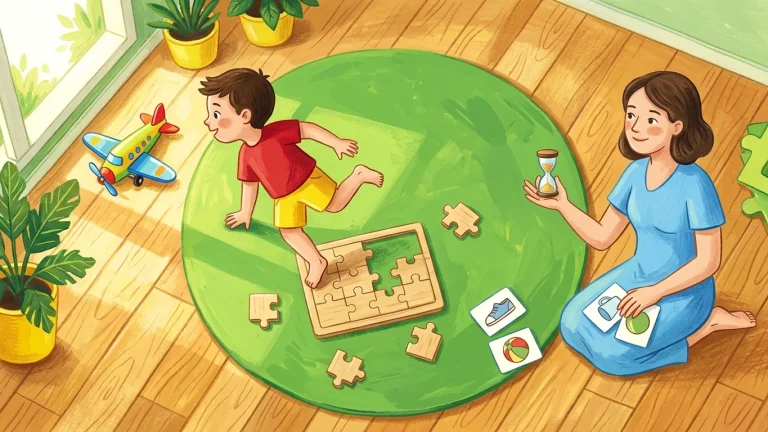
- Rolling log: On a soft mat, the child stretches their arms above their head and rolls sideways. Do just two rolls at first.
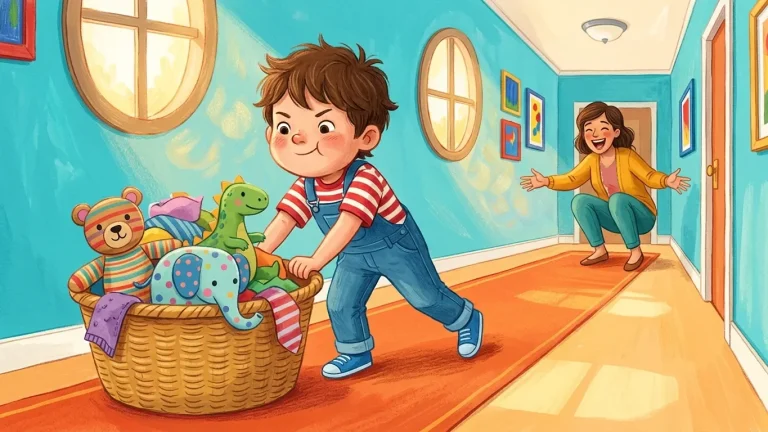
- Animal walks: Cross the hallway with bear steps one day and as a crab walking backwards the next. Then try bunny hops. This way the head moves into different positions.
- Bouncing on a gym ball: The child sits on a large ball and bounces gently while you hold their waist. Trunk muscles and balance work together.
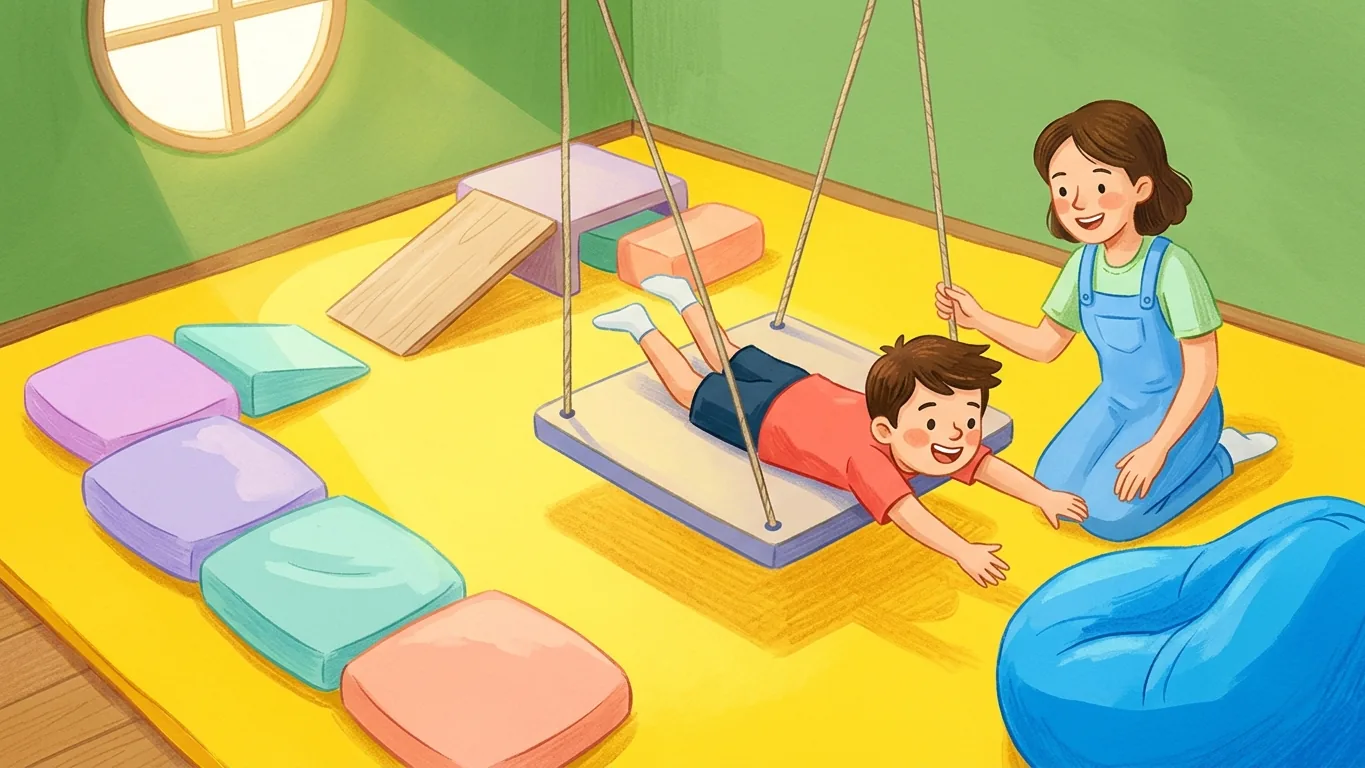
- Aeroplane game: The child lies on their tummy and lifts their arms and legs off the floor. This position combines vestibular system input with trunk strength.
- Cushion obstacle course: Lay out cushions, mats and a low stool on the floor. The child keeps adjusting their balance across the different surfaces.
- Rhythmic rocking: Read a book together in a rocking chair or hammock. Slow, steady rocking calms most children.
- Slide and ramp: Try sliding sitting up first, then on the tummy. For a fearful child, start from a single step.
- Dance and freeze: The child spins while the music plays and becomes a statue when it stops. This keeps the spinning short and controlled.
- Upside-down games: On a big mat, the child bends forward and looks at you between their legs. This simple move switches on the otolith organs.
For Arda, we chose only the blanket swing in the first week. The blanket was a hand's width off the floor, and Arda ran the swinging himself by saying "stop" and "go". Three weeks later he sat in the baby swing at the park of his own accord.
5 safety rules
- Never spin a child against their will or push them into a movement they do not want.
- Leave control with the child as much as possible, and stop at once when they say "stop".
- End the game if you see paleness, sweating, yawning or hiccups.
- Plan short turns with rest breaks instead of long, non-stop spinning.
- Follow movement with a calm activity, such as reading a book on your lap.
Placing these games at set times of the day also boosts their effect. We explain step by step how to build such a plan in our article on the sensory diet.
Vestibular system support at school and nursery
The classroom is one of the places where vestibular system difficulties show most. Children are expected to sit still for long periods. For a movement-seeking child, that expectation is almost impossible.
So we suggest discussing a few small changes with the teacher. For example, the teacher can ask the child to wipe the board, hand out books or take a note to the door between tasks. This way the child meets their need for movement without disrupting the class.
Seating makes a difference too. A chair that lets the feet rest on the floor, an air-filled seat cushion or back support relaxes the trunk. As a result, the child puts the energy they spent on balance into the lesson.
For a child with gravitational insecurity, however, the real challenge is playtime. This child keeps away from the slide, the climbing wall and busy running games. So ask the teacher not to push the child, but to offer a low, safe starting point.
Also look at how your child sits. Some children sit on the floor with their legs spread out to each side to make balance easier. We cover this in detail in our article is W-sitting harmful.
How is the vestibular system assessed in occupational therapy?
At the first meeting we usually listen to you first. You know best how your child behaves at the park, in the car and at home. We then use a sensory profile questionnaire to organise these observations.
Next, we watch the child's vestibular system at work during play. For example, we look at how they manage on a swing, walking along a beam, standing on one leg and catching a ball. We also watch their eye movements and how long they take to regain balance after spinning.
Finally, if needed, we refer you to an ENT specialist for medical balance checks. This way we build the sensory plan without missing a medical cause. You can find the general flow of an assessment in our article how an occupational therapy assessment works.
How does the process work at Çocukla Akademi?
At our centre we work on the vestibular system with suspended swings, a hammock, ramps and balance platforms. Each session lasts 40 minutes and is planned around the child's profile. We choose intense but guided input for a movement-seeking child, and small, safe steps for a fearful one.
At the end of each session we also give you one or two games to use at home. A few hours of therapy a week grows stronger through small moments repeated at home every day.
Throughout the process we set vestibular system goals together with you and review progress every month.
For example, the first month's goal might be sitting on a swing at the park, and the second month's goal sliding down on their own. Sessions are available in English, and bilingual Turkish-English sessions are offered too; we describe our approach on our occupational therapy page.
4 myths about the vestibular system
"If a child who spins a lot does not get dizzy, there is no problem"
In fact, this can be a clue in the other direction. Never feeling dizzy despite spinning suggests the vestibular system registers little input. Still, do not draw a conclusion from this alone; look at the whole picture.
"If they are scared, pushing them will help them get used to it"
No. Pushing reinforces the fear and shakes your child's trust in you. So always let progress follow your child's pace.
"A swing is just for fun"
Of course a swing is fun, but it is also strong sensory input. Swinging at the right rhythm calms many children, while fast swinging wakes them up.
"They will grow out of it"
It is true that it eases with time in some children. But a child with gravitational insecurity can miss years of sport, play and friendship. Early support gives those years back.
Frequently asked questions
Where is the vestibular system?
The vestibular system sits in the inner ear, right next to the hearing organ. It is made up of the fluid-filled semicircular canals and the otolith organs. These structures tell the brain about the head's movement and position.
My child spins all the time. Is this normal?
Many children love spinning, and this is usually normal. But if spinning takes up much of the day, or your child becomes very distressed when stopped, ask for an occupational therapy assessment.
What can I do for a child who is scared of swings?
Start with a swing close to the ground that their feet can touch. Leave the swinging under your child's control and stop at once when they say "stop". If the fear lasts for weeks, get specialist support.
Is car sickness linked to the vestibular system?
Yes, car sickness happens when information from the inner ear and the eyes does not match. Mild car sickness is common in children. But if your child vomits often even on short journeys, talk to your doctor.
Can the vestibular system affect attention and school?
It can. A child who works hard to stay balanced fidgets on the chair and tires quickly. A child who struggles to keep the image steady while the head moves also loses the line when copying from the board.
Which specialist should see a vestibular system problem?
If there is dizziness, an ear complaint or sudden loss of balance, see your paediatrician and an ENT specialist first. For sensory processing difficulties, an occupational therapist carries out the assessment. In some children both paths run together.
How much vestibular play should we do at home each day?
No fixed time suits every child. Several short breaks spread through the day usually work better than one long session. Watch your child's reaction and set the time together with your therapist.
Is a trampoline good for the vestibular system?
A trampoline gives strong vestibular input, and movement-seeking children love it. But choose a single-user trampoline with a safety net and always supervise your child. Do not push a child with gravitational insecurity onto it.
Related articles
We have gathered the general signs of sensory difficulties in our article on signs of sensory processing disorder. For children who fall often, see our guide to the clumsy child and developmental coordination disorder, and for ideas that feed the senses at home, read our article on sensory play.
Sources
The figures on dizziness and balance problems in childhood in this article are based on the following source:
- NIDCD (US National Institutes of Health). More than 1 in 20 U.S. children have dizziness and balance problems, 2016. Study: Li CM, Hoffman HJ et al., The Journal of Pediatrics.