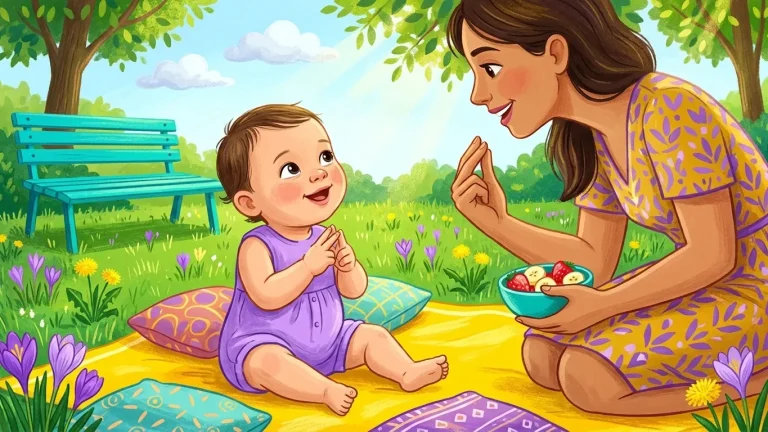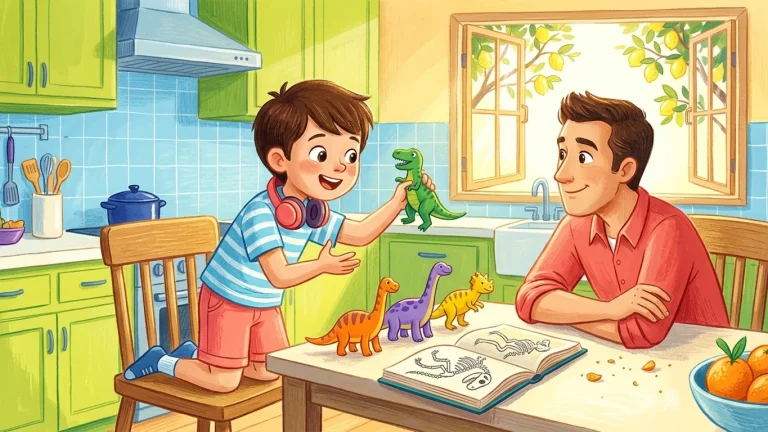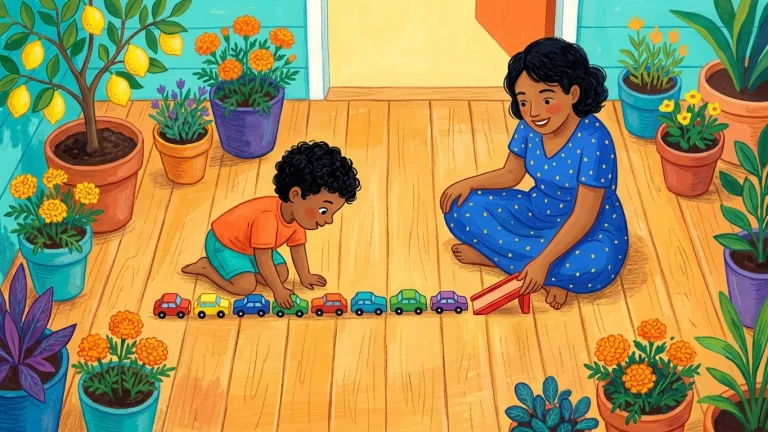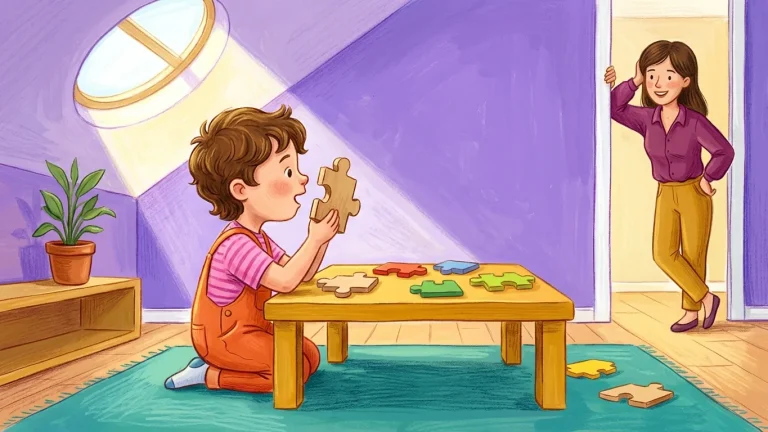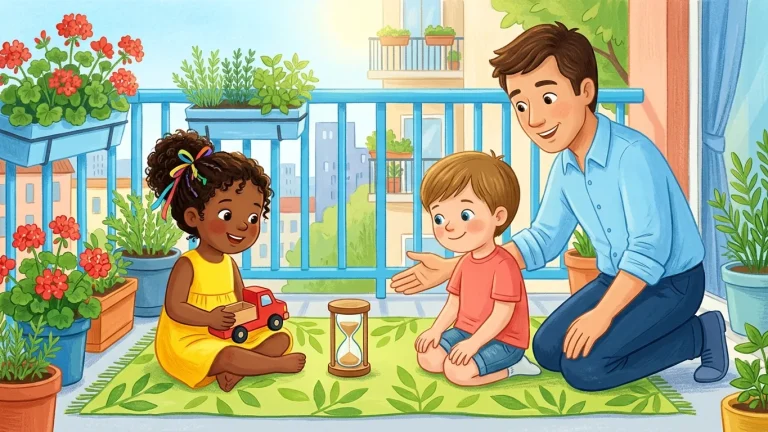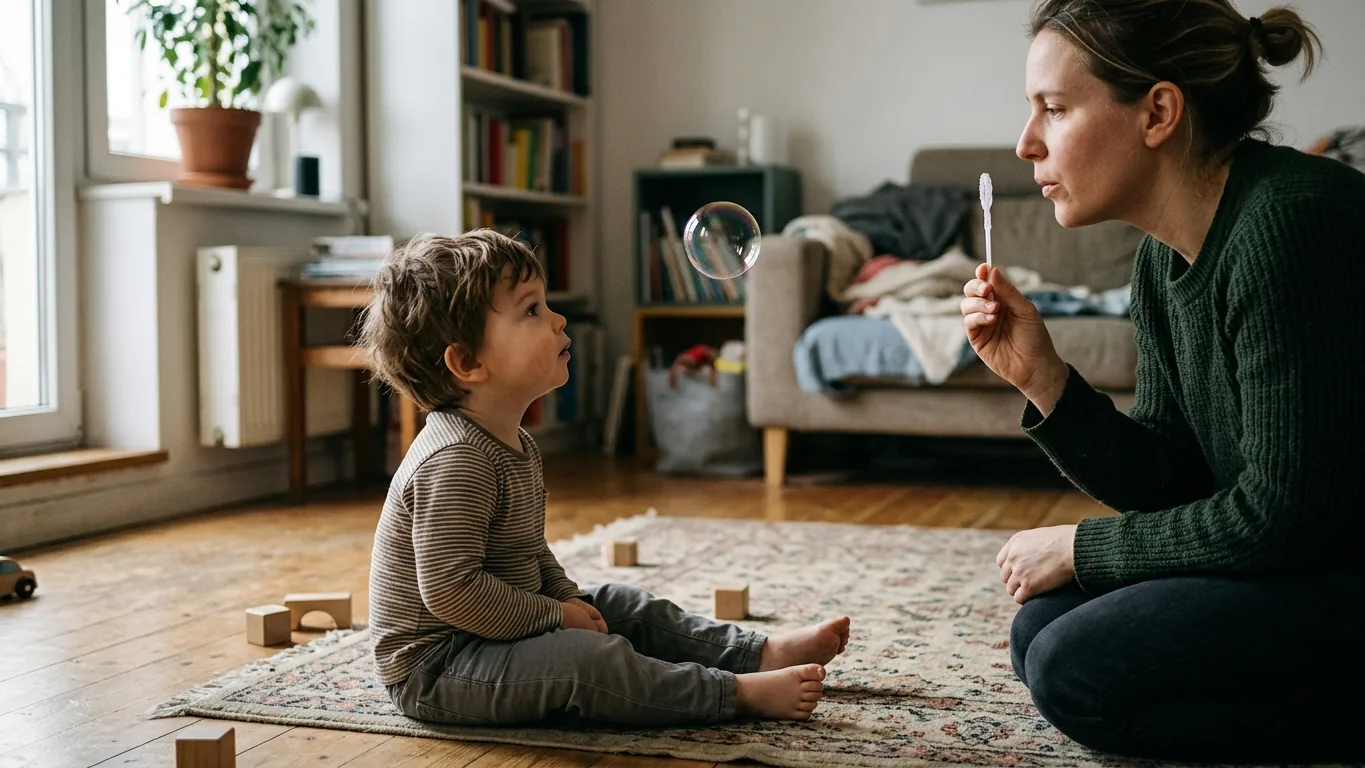
Joint attention is when a child looks at something together with you and shares that interest with you. It usually becomes clear between 9 and 18 months and is one of the building blocks of language. In this guide we explain the 5 stages of joint attention, the warning signs and 7 games you can play at home.
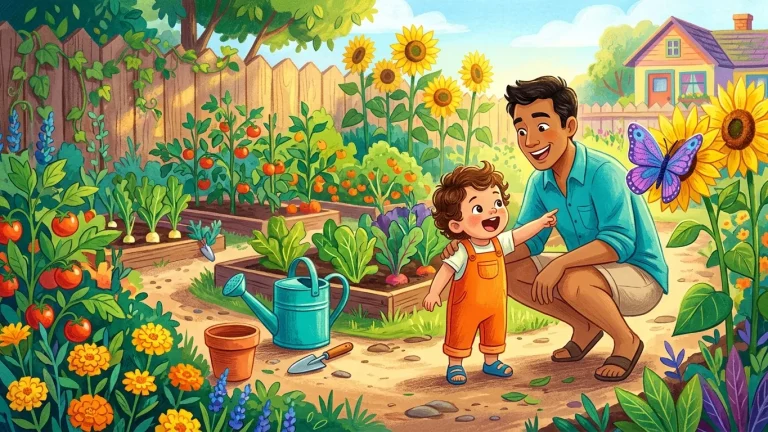
Last week a father asked us at the start of a session: "I point at a plane from the window, but my son keeps looking at my finger."
This question goes to the heart of joint attention. To look at the plane, the child has to understand that a finger points in a direction. And when he looks at the plane and then turns back to his father, that is the first way of saying "did you see it too?"
The good news: joint attention is a skill that grows stronger at home with the right games. So we first explain what the skill is, then what you can do at home, step by step.
What Is Joint Attention?
Joint attention means two people focusing on the same thing and letting each other know it. For example, a child looks at a dog, turns to their mother's face, then looks back at the dog. In this way an invisible triangle forms between the child, the mother and the dog.
You may also see it called "shared attention". Whatever the name, the core idea is the same: two people look at the same thing, together and on purpose.
Eye contact on its own is not joint attention. In eye contact two people look at each other, while in joint attention they look together at a third thing. We explain this difference in detail in our article on the child who does not make eye contact.
Two Sides of Joint Attention: Responding and Initiating
Researchers divide joint attention into two main directions. First, the child responds when someone else directs their attention. Then, over time, the child starts to initiate it.
| Type | What does the child do? | Everyday example |
|---|---|---|
| Responding to joint attention | Follows your gaze or your point | Turns to the cat when you say "Look, a cat!" |
| Initiating to request | Points to get something | Points at the biscuits on the shelf and looks at you |
| Initiating to share | Points or brings something just to show it | Points at the plane and looks at your face with excitement |
The third row matters most. Pointing to share shows that the child has noticed you have an inner world too. In autistic children, pointing to request is often present, while pointing to share tends to lag behind.
When Does Joint Attention Develop? 5 Stages
Joint attention does not appear all at once; it develops in stages. Carpenter, Nagell and Tomasello followed 24 babies every month between 9 and 15 months in 1998. The babies first learned to share attention, then to follow it and finally to direct it.
The ages below are averages and a gap of a few months is normal. For babies born prematurely, use their corrected age.
| Stage | Approximate age | What do you see? |
|---|---|---|
| 1. Face-to-face sharing | 2 to 6 months | Looks at your face and smiles back at your smile |
| 2. Following gaze | 6 to 9 months | Looks where you turn your head |
| 3. Following a point | 9 to 12 months | Looks at the object you point to, not at your finger |
| 4. Requesting and showing | 12 to 15 months | Points to what they want and holds out a favourite toy to show you |
| 5. Pointing to share | 15 to 18 months | Points at something interesting, then turns to check your face |
The US Centers for Disease Control and Prevention (CDC) milestone list gives a similar order. Most children point to ask for something by 15 months and point to show you something interesting by 18 months. These lists describe skills that about three in four children reach by that age.
After 18 months the child adds words to these looks. For example, they point and say "bird!" and wait for your reaction. In this way joint attention becomes the ground for the first conversations.
You can find the language milestones by age in our article on language development from 0 to 6 years.
Why Does Joint Attention Matter So Much?
Joint attention is the doorway to learning words. If your child is looking at the ball when you say "ball", they link the word to the object. If they are looking somewhere else, the same word just floats away.
The findings of Carpenter and colleagues support this. The moments when mothers named what their baby was already looking at predicted the first gestures and words. In other words, a parent who joins the child's interest opens the shortest path to language.
Joint attention is also the basis of play and social understanding. For example, pretend play, taking turns and guessing what someone else is thinking all build on this foundation.
In 2016 Bottema-Beutel combined 71 studies in a single analysis. The link between joint attention and language was stronger in autistic children than in typically developing children. Responding to joint attention was the type most closely tied to language.
Signs of Joint Attention Difficulties
Judge the signs below over a few weeks of observation, not on a single day. A tired or unwell child may not look at all one day and look easily the next.
- At 12 months they look at your finger, not where you point.
- At 15 months they do not point to what they want and lead you there by the hand instead.
- At 18 months they do not bring things or point to show you something interesting.
- During play they do not turn to your face to check your reaction.
- They do not turn, or rarely turn, when you say their name.
- They show no interest when you look at something with excitement.
- They have words, but do not use them to show you things.
Using your hand like a tool is a common sign. The child gets what they want, but does not share their gaze with you. We cover responding to name separately in our article on the child who does not respond to their name.
Joint Attention and Autism
Difficulty with joint attention is one of the earliest and most consistent signs of autism. That is why many questions in the M-CHAT screening questionnaire ask directly about this skill. For example, it asks whether the child points to show you something interesting.
However, joint attention difficulties alone do not mean an autism diagnosis. Only a child and adolescent psychiatrist or a developmental paediatrician can diagnose autism. Our centre does not diagnose; we assess language, communication and play through observation and plan therapy.
If autism is on your mind, our articles on signs of autism and autism or speech delay will help you with the first step.
Other Conditions That Affect Joint Attention
Not every child who does not look is autistic. Several other conditions can create a similar picture. So the right first stop depends on the situation.
| Condition | What does it look like? | First step |
|---|---|---|
| Hearing loss, glue ear | Turns late to spoken cues, responds better to visual cues | Audiological assessment and ENT |
| Vision problem | Cannot follow distant objects, no trouble with near ones | Paediatric eye doctor |
| Heavy screen exposure | Less interest in faces, absorbed by the screen | Cut screen time and observe for a few weeks |
| Global developmental delay | Joint attention and other skills are all behind | Paediatrician, developmental assessment |
| Sensory overload | Switches off in crowds, looks in calm settings | Occupational therapy assessment |
| Prematurity | Behind for actual age, on track for corrected age | Follow-up using corrected age |
Do not skip hearing. Every spoken "look!" fails to reach a child who does not hear well. We explain this from an audiologist's point of view in our article on glue ear and speech delay.
Joint Attention Activities at Home: 5 Key Principles
Joint attention activities at home need no special materials. But a few principles make the same game far more effective.
1. Follow your child's interest
First, look at what your child is looking at and name it. Joining their interest is much easier than trying to change it. Carpenter's findings show that exactly this approach predicts language.
2. Get down to face level
If your child is on the floor, sit on the floor too. That way your face and the toy are in the same field of view. Sit in front of your child and do not talk from behind them.
3. Bring the object next to your face
For example, hold the bubble wand right next to your eyes. Then, while looking at the bubbles, your child also sees your face. Over time they start shifting their gaze between the object and your face.
4. Pause and wait
Stop suddenly at the most exciting moment of a game. Then wait quietly for about five seconds. Most children look at your face to ask "why did you stop?", and that look is a moment of joint attention.
5. Keep it short and lively
With young children, exaggerate your facial expression a little and name things with one word. For example, "Wow, bird!" works better than a long sentence. When your child looks at you, smile straight away so that looking pays off.
7 Games That Build Joint Attention
The games below work on different stages of joint attention. Start at the stage your child is at and move up gradually.
| Game | How to play | Target | Age |
|---|---|---|---|
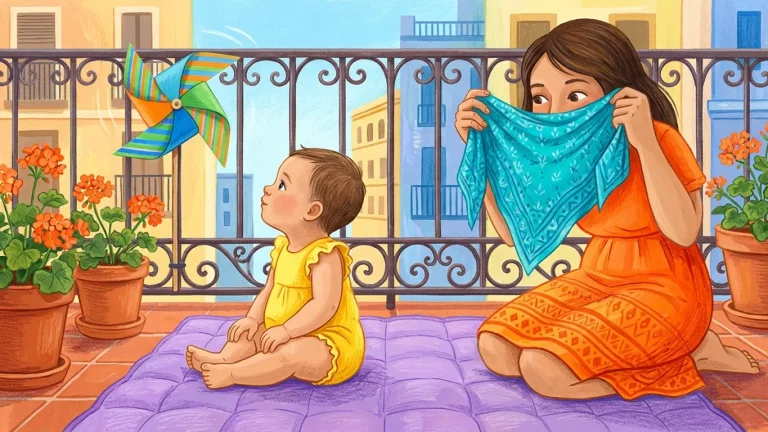
| 1. Peekaboo | Hide your face under a cloth and reveal it with "peekaboo!" | Face-to-face sharing | 6 months and up |
| 2. Bubbles | Blow bubbles, then hold the wand next to your face and wait | Looking between face and object | 9 months and up |
| 3. Rolling a ball | Roll the ball, say "to me!" and open your hands | Turn-taking and gaze | 12 months and up |
| 4. Hidden toy | Put a toy somewhere visible and show it with your eyes and finger | Following a point | 12 months and up |
| 5. Window watching | Point at a bird, cat or car and name it | Following distant objects | 12 months and up |
| 6. Knocking down a tower | Stack blocks together, pause before knocking it down and wait for a look | Shifting gaze | 15 months and up |
| 7. Picture book | Point at a picture and name it, then wait for your child to point | Pointing to share | 15 months and up |
Bubbles are the easiest start for most children. They catch attention and float right in front of your face. And to say "again!" the child has to look at you.
In the hidden toy game, first turn only your eyes towards the toy. If your child does not follow, add your finger. When they find the toy, celebrate together so that following is rewarded with shared joy.
For books, the interactive reading techniques in our article on reading to your child work directly on joint attention. Play these games several times a day in short bursts of five to ten minutes.
Everyday Moments for Joint Attention
You do not need a separate playtime for joint attention. For example, name the foam in the bath, the spoon at mealtimes and the sock while dressing, together. At the supermarket, point at an apple, say "apple!" and wait for a look.
These routines repeat every day. So your child plays the same little game again and again, and the skill sticks. You can find more on this approach in our article on doing Floortime at home.
How to Track Joint Attention Progress at Home
Counting progress, rather than just sensing it, reassures both you and the therapist. Once a week, at the same time, choose ten minutes of free play. During that time, keep a tally of these three behaviours on a sheet of paper.
- Responding: How many times did they look at what you showed them?
- Shifting gaze: How many times did they turn from the toy to your face on their own?
- Sharing: How many times did they hold something out or point to show you?
For example, seeing only two responses and no sharing in the first week is normal. Responses usually increase first, then gaze shifts. Sharing comes last, so be patient.
Bring these sheets to your therapy meetings. Together we can see which game is working and update the home plan.
Screens and Joint Attention
Screens train the opposite of joint attention. A cartoon catches the child's gaze, but there is no face looking back and reacting. So keep screens to a minimum under the age of two.
If the screen is on, sit with your child, point at things on it, name them and wait for them to turn to you. See our article on screen time and language development for more.
5 Common Mistakes Parents Make
Turning the head by hand: Steering the gaze by force brings a brief look. But it does not create a wish to share, and it can pull the child away from play.
Repeating "look at me": This command turns looking into a task. Joint attention comes naturally when there is something worth looking at.
A flood of questions: Questions like "What is this? What colour is it?" turn play into a test. Make short comments instead, such as "Red car, so fast!"
Taking over the game: Taking the toy and setting up your own game breaks their interest. Add a small twist to their game instead.
Missing the look: If you are on your phone when your child looks at you, the moment is lost. Leave the phone in another room during play.
How Is Joint Attention Worked On in Therapy?
Joint attention is one of the most researched skills targeted directly in autism. In 2006 Kasari and colleagues divided 58 autistic children aged 3 to 4 into three groups. After 30 minutes a day for 5 to 6 weeks, the joint attention group did better than the control group in showing and responding.
At the one-year follow-up in 2008, expressive language grew more in both therapy groups than in the control group. Joint attention work made the biggest difference for the children with the least language. We describe the JASPER approach that grew from this research in our article on autism therapy approaches.
At our centre we work on joint attention within DIR Floortime, starting from the child's own interests. The speech and language therapist and the occupational therapist build the plan together.
For example, for a child who is sensorily disorganised, we first target regulation, then joint attention games. Parents join the sessions, because the real progress happens at home. For children who do not speak, we also add PECS and alternative communication support when needed.
When Should You See a Specialist About Joint Attention?
If any of the following applies, do not wait; arrange an assessment. Early support brings the fastest progress in joint attention.
- At 12 months they hardly ever turn to their name or to where you point
- At 15 months they never point to ask for something
- At 18 months they do not point or bring things to show you
- They have lost looking, pointing or words they used to have
If skills are lost, do not wait at all and talk to your paediatrician first. Then, if needed, arrange child psychiatry, audiology and speech and language assessments. We explain how an assessment works in our article on speech and language assessment.
Frequently Asked Questions
What is joint attention?
Joint attention is when a child looks at an object or event together with you and shares that interest through gaze or pointing. It is one of the core skills for language, play and social development.
At what age does joint attention start?
The first signs appear at 6 to 9 months with following gaze. Following a point comes at 9 to 12 months, and pointing to share at 15 to 18 months.
Is a lack of joint attention a sign of autism?
It is one of the earliest signs of autism, but on its own it does not mean a diagnosis. Hearing, vision and overall development can create a similar picture. A child and adolescent psychiatrist makes the diagnosis.
Is joint attention the same as eye contact?
No. In eye contact two people look at each other. In joint attention they look together at a third thing and shift their gaze between it and each other.
My child points to what they want but never shows me things. Is that a problem?
Pointing to request develops before pointing to share. But if at 18 months your child still only points to request, arrange an assessment.
Can joint attention develop later?
Yes. Studies by Kasari and colleagues showed that targeted joint attention work supports this skill and later language development, even in autistic children. That is why starting early matters.
How long should joint attention activities at home last?
Short games of five to ten minutes, several times a day, are enough. Also turn routines such as bath time, meals and dressing into moments of joint attention.
Can a child who talks have joint attention difficulties?
Yes. Some children say many words, but use them only to request or repeat, not to share. In that case it is worth assessing pragmatic language skills too.
Which specialist should I see about joint attention?
Talk to your paediatrician first. A speech and language therapist works on communication and play, and an occupational therapist on sensory regulation. If autism is a question, see a child and adolescent psychiatrist.
In short, joint attention is the moment your child starts sharing the world with you. Follow their interest, get down to face level and always respond when they look at you. If you see no progress in a few weeks, arrange an assessment.
For related topics, see our articles on pragmatic language disorder, echolalia and the 2-year-old who is not talking.
Sources and Further Reading
In writing this article we drew on published research on joint attention and an official milestone list. The links below cover the topic in more detail.
- Carpenter M, Nagell K, Tomasello M. Social cognition, joint attention, and communicative competence from 9 to 15 months of age, Monographs of the Society for Research in Child Development, 1998.
- Kasari C, Freeman S, Paparella T. Joint attention and symbolic play in young children with autism: a randomized controlled intervention study, Journal of Child Psychology and Psychiatry, 2006.
- Kasari C et al. Language outcome in autism: randomized comparison of joint attention and play interventions, Journal of Consulting and Clinical Psychology, 2008.
- Bottema-Beutel K. Associations between joint attention and language in autism spectrum disorder and typical development, Autism Research, 2016.
- CDC. Learn the Signs. Act Early: Milestones, US Centers for Disease Control and Prevention.